Today's
EarthStation1.com 15% (Or More!) Off Commemorative Memorial Title:
TV Commercials: The Classics Vol. 3 DVD, Video Download, USB Drive
Today, August 6, 2026
August 6: National Fresh Breath Day: --
An annual reminder to pop a mint and smile! This day urges
appreciation of oral hygiene and its importance. Dentists and oral
care professionals applaud the day dedicated to fighting bad
breath. Oral hygiene and the fresh breath associated with it are
part of healthy, daily habits. Over time, poor dental care will
cause mouth odor. Of course, the foods we eat contribute to bad
breath, too. However, bad breath may be a symptom of a health
condition or a side effect of a medication. There are ways to
combat bad breath: Brush after meals; Floss before bedtime; Gargle
and rinse with mouthwash regularly; Chew sugar-free gum to keep
the mouth moist; Stay hydrated; Seek regular dental care. Alcohol
consumption dries out your mouth causing bad breath, so drink
moderately. Carry sugar-free gum. When you take out a piece, offer
one to your companions. Those with bad breath won't know you're
giving them a hint; they'll think you're being polite and sharing!
If you battle bad breath and suspect it's the result of a deeper
issue, consult your physician. On Sale Until Midnight Tonight PT!
https://store.earthstation1.com/tv-commercials-the-classics-vol-3-dv3.html
Today's
EarthStation1.com 15% (Or More!) Off Commemorative Memorial Title:
A Bicycle Built For Thee: Bicycling Films DVD, MP4 Download, USB
Drive
Today, August 6, 2026
August 6: Cycle To Work Day (UK): --
Bicycle riding is one of the best ways to get exercise into your
daily routine. But have you ever thought about taking your bicycle
and riding it to work? Well, there's a day dedicated towards just
that. As a holiday that just requires you and your bike, it's one
of the most celebrated holidays in the world because of how bike
riding is such a popular activity. Read more about Cycle to Work
Day's history and see how you can participate in this awesome day.
Cycle to Work Day has been created in order to encourage people to
do just that: cycle to work. It encourages people to give their
bike a go and cycle to work, at least for one day of the year.
There are so many different benefits that are associated with
cycling to work. Not only is this good for your health but you are
going to be doing your bit for the environment as well. There have
even been government and state initiatives created around the
world to encourage people to cycle to work more often. There are
many different reasons why you should consider biking to work.
Firstly, you may find that it is actually a lot of fun! Plus,
biking to work is good for you! You are going to start the day off
with some exercise, and there is no better way to start the day.
This will make you feel good and happy for the rest of the day.
After all, exercising releases those chemicals that make us feel
happy. There are a number of other benefits to consider as well.
For example, you are going to be able to save a considerable
amount of money by cycling to work. It is worth totalling up how
much you currently spend on your commute to work, whether you
drive there or take the train. This money only adds up over time.
When you cycle to work, the only expense you are going to have is
your bike and a lock to secure it. If you calculate the difference
over the course of a year, you are going to be able to save quite
a lot of money! You will probably be surprised by just how much.
So, you get fresh air, you can avoid traffic jams, you get some
exercise added to your daily routine, and while you do this, you
get to save a considerable amount of money in the process. Sounds
good, right? Cycle to Work Day has multiple origins because it
takes place on multiple days throughout the spring season. Cycle
to Work Day is believed to have been started by the League of
American Bicyclist in 1956. Places throughout the United States,
Canada, and Europe take part in this holiday because bicycling has
become a popular way of travel and a popular way of exercise.
However, today's holiday takes place in the United Kingdom.
According to cycletoworkday.org, Cycle to Work Day began in 2013
and has since grown into one of the most popular events in the
United Kingdom. This day encourages adults to get on their bike
and cycle to work just for one day. They believe that cycling can
help improve the lives of adults everywhere by bringing health and
fitness in just one day. One day can make all the difference and
can get people hooked on bicycle riding for the rest of their
lives. According to their website, in 2017 over 40,000 riders
helped them celebrate the day and over a million miles were cycled
as a result. As the holiday becomes ever more popular, the event
coordinators that help operate the site hope that everyone who
participates can be able to have fun and incorporate an awesome
workout routine into their daily lives. On Sale Until Midnight
Tonight PT!
https://store.earthstation1.com/a-bicycle-built-for-thee-classic-bicycling-films-dvd.html
Today's
EarthStation1.com 15% (Or More!) Off Commemorative Memorial Title:
Watch Mr. Wizard Science TV Kid Shows Don Herbert DVD, MP4, USB
Drive
Today, August 6, 2026
August 6: Balloons To Heavens Day: --
Today we remember the countless lives lost to gun violence. The
pain of losing a loved one never fades. It resurfaces when we
least expect it - as sorrow, longing, or even comfort. One carries
grief along but live with the loss you must. Balloons to Heaven
Day encapsulates all these truths and more. Releasing balloons in
the sky is symbolic. Each person takes away something different
from the experience. But it unites families in their sorrow, with
the hope that everyone can heal together. It's a time for families
everywhere to mourn loved ones and keep up the fight to end gun
violence. From cultural practices to personal traditions, rituals
help us make sense of the world. They articulate our deepest
emotions and bring joy to life's milestones, from the birth of a
child to wedding anniversaries. When a loved one passes away,
rituals can help ease the pain. Rituals allow us to pause,
remember, and eventually find healing. Symbolic acts like
releasing balloons remind us that our loved ones are always with
us. A quiet, meditative activity that's at once joyful and solemn.
Everything about the ritual conveys a sense of lightness. It's the
hope that those we love are at peace and gives comfort to people
still grieving. As a universal expression of feeling, releasing
balloons has also become a way to deter gun violence in the U.S.
Every year, more Americans die as a result of gun-related
incidents. Statistics show that gun deaths in the U.S. have
increased by 43% compared to the previous decade. Since Columbine,
more than 292,000 students have experienced gun violence in
schools. Balloons to Heaven Day hopes to create awareness of the
pain and trauma that gun violence causes to families all over the
U.S. A day when we remember the senseless deaths of thousands of
people, often children and young people. For families who've lost
loved ones, it's a day to release their spirits, send them love,
and celebrate their lives. Many people write notes and attach them
to the balloons before releasing them. Most importantly, balloons
are visual reminders to families everywhere who are coping with
grief. A reminder that they are not alone in their pain. On Sale
Until Midnight Tonight PT!
https://store.earthstation1.com/watch-mr-wizard-dvd-old-time-tv-kid-shows.html
Today's
EarthStation1.com 15% (Or More!) Off Commemorative Memorial Title:
Labor Union Films Collection DVD, Video Download, USB Flash Drive
Today, August 6, 2026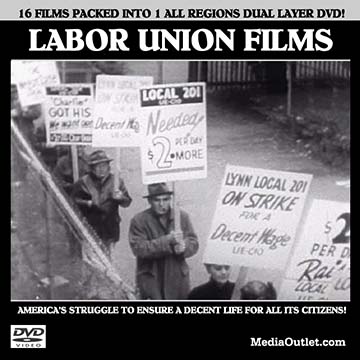
August 6: Farmworker Appreciation Day: -- This day aims to raise awareness about the importance of the work that people do on the farm. The truth is that farmworkers work even under the hot summer sun to bring in the harvest. Every year, you can see them as you are driving by the fields. Most of their work only happens during summer, and this means that many of these individuals return to their home country when the season is over. Farmworkers are usually forgotten and this day is special to honor and thank them for all they have done. In the colonial era, most farmworkers were indentured servants from Great Britain. They were white men and women, and even children, who exchanged four to seven years of hard labor for passage to the colonies. Some of these workers were recruited through force and were kept and sold as property, with few rights. They lived in miserable conditions of servitude and abuse. By the 1600s, indentured servants weren't plentiful enough, so plantation owners turned to an even crueler method of workforce recruitment: the forceable capture of Africans to be converted into slaves. These slaves had almost no promise of eventual freedom as no fixed period of enslavement was arranged. African slaves became the primary source of farm labor in the colonies over the next two centuries. By the end of the American Revolution, 20% of the population in the 13 colonies was of African descent, the majority of whom were slaves. In 1808, Congress banned the international slave trade, but not the practice of slavery itself. California became a major agricultural center after the Civil War in the United States. In the aforementioned state, farm labor was mostly imported from Asia. The immigrant labor force had begun to shift to Mexico by the 1930s. During World War II, due to a labor shortage, the Bracero Program was initiated. This program allowed Mexicans to work temporarily on U.S. farms. It ended in 1964, although Latin American legal and illegal immigrants continue to make up the vast majority of the U.S. agricultural workforce. On Sale Until Midnight Tonight PT! https://store.earthstation1.com/labor-union-films-dvd.html
Today's
EarthStation1.com 15% (Or More!) Off Commemorative Memorial Title:
Pirates 12 Part Documentary Series MP4 Video Download DVD
Today, August 6, 2026
August 6: Jamaica Independence Day: --
August 6, 1962: Jamaica achieves its independence after centuries
of British and Spanish rule. During 150 years of Spanish rule,
African slaves were first brought to the island. The British
invaded in 1655 and the slave trade greatly expanded during the
1700s. Following the abolition of slavery in the 1830s, Jamaica
remained a British colony. Jamaica Independence Day became a
national celebration in 1962 when Jamaica became independent with
full dominion status in the Commonwealth, under a constitution
that retained the British monarch as head of state. The first
elected Prime Minister was Alexander Bustamante. Jamaica's
independence meant that Britain no longer controlled the country's
affairs. Thus, these became primarily managed by the new Prime
Minister and his locally elected cabinet. Furthermore, Jamaica's
independence also meant that they had to form a constitution,
symbols, emblems, army, currency, and passports. Jamaica was one
of the first colonies in the so-called 'new world.' Jamaica became
a Spanish colony in 1509. In May 1655, the British took over the
island during the Anglo-Spanish War. In the 1950s, the British
Empire broke up; thus, Jamaica took advantage of the situation to
make several amendments to its constitution to allow greater
self-government and a Prime Minister. In 1958, Jamaica joined the
West Indies Federation - a political union of various Caribbean
islands that were also colonies of the United Kingdom. By
September 1961, Jamaicans had become dissatisfied with the
Federation. The slow-paced move to independence led to a
referendum in Jamaica where 54% of Jamaicans voted to leave the
Federation. In 1962, the 'Jamaica Labour Party,' under the
leadership of Bustamante, won the elections, which resulted in the
passing of the Jamaica Independence Act by the United Kingdom
Parliament on July 19, 1962. On August 6, 1962, the British
granted them independence, and the Jamaican flag flew for the
first time. Bustamante became Jamaica's first Prime Minister, with
Jamaica joining the Commonwealth of Nations. The main highlight of
Jamaica Independence Day is the 'Jamaica Independence Festival,'
which showcases a grand parade, traditional music, the World
Reggae Dance Final, and other events. On Sale Until Midnight
Tonight PT!
https://store.earthstation1.com/pirates-12-part-documentary-series-mp4-video-download-124.html
Today's
EarthStation1.com 15% (Or More!) Off Commemorative Memorial Title:
Hiroshima Atomic Bombing Documentaries DVD, Video Download, USB
Drive
Today, August 6, 2026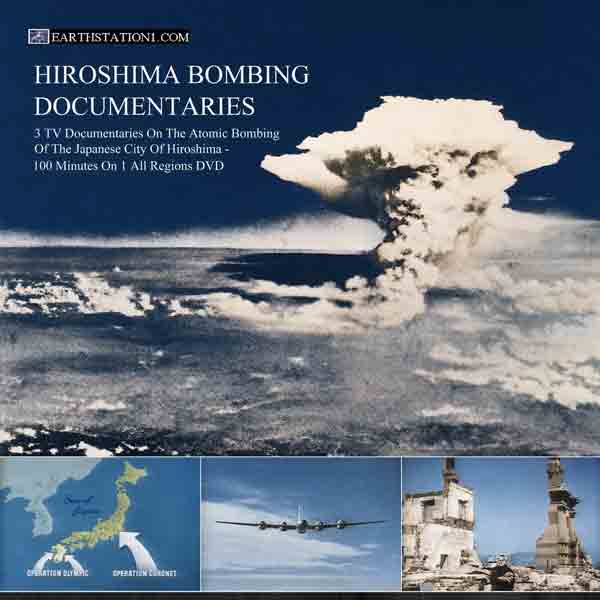
August 6: Hiroshima Day: -- World War II:
The Pacific War (The Asia-Pacific War, The Pacific Theater Of
World War II): The Asiatic-Pacific Theater: Aviation: Military
Aviation: Air Warfare Of World War II: Air Warfare Of The Pacific
War: Air Raids On Japan: Nuclear Weapons Programs Of The United
States: The Manhattan Project (Codename: Development Of Substitute
Materials): Nuclear Warfare: American Nuclear Warfare: Little Boy:
Enola Gay: The Atomic Bombing Of Hiroshima: -- The first use of an
Atomic bomb in warfare occurs, dropped over the center of the
Japanese city of Hiroshima at 8:15 a.m. as part of "Special
Mission 13" by the 393rd Bombardment Squadron's Boeing B-29
Superfortress heavy bomber named Enola Gay, named after squadron
commander and Enola Gay Pilot Colonel Paul Tibbets's mother, which
took off from North Field, Tinian, about six hours' flight time
from Japan, along with its accompanying B-29s named The Great
Artiste, commanded by Major Charles Sweeney, which carried
instrumentation, and a then-nameless aircraft later named
Necessary Evil, commanded by Captain George Marquardt., the latter
which was the photography aircraft. The bomb detonated about 1,800
ft. above ground, destroying the city, and killing around 70,000
people instantly and over 105,000 persons in subsequent years from
burns and radiation poisoning. After leaving Tinian, the aircraft
made their way separately to Iwo Jima to rendezvous at 05:55 at
2,800 meters (9,200 ft), and set course for Japan. The aircraft
arrived over the target in clear visibility at 9,470 meters
(31,060 ft). Parsons, who was in command of the mission, armed the
bomb in flight to minimize the risks during takeoff. He had
witnessed four B-29s crash and burn at takeoff, and feared that a
nuclear explosion would occur if a B-29 crashed with an armed
Little Boy on board. His assistant, Second Lieutenant Morris R.
Jeppson, removed the safety devices 30 minutes before reaching the
target area. During the night of August 5-6, Japanese early
warning radar detected the approach of numerous American aircraft
headed for the southern part of Japan. Radar detected 65 bombers
headed for Saga, 102 bound for Maebashi, 261 en route to
Nishinomiya, 111 headed for Ube and 66 bound for Imabari. An alert
was given and radio broadcasting stopped in many cities, among
them Hiroshima. The all-clear was sounded in Hiroshima at 00:05.
About an hour before the bombing, the air raid alert was sounded
again, as Straight Flush flew over the city. It broadcast a short
message which was picked up by Enola Gay. It read: "Cloud
cover less than 3/10th at all altitudes. Advice: bomb primary."
The all-clear was sounded over Hiroshima again at 07:09. At 08:09,
Tibbets started his bomb run and handed control over to his
bombardier, Major Thomas Ferebee. The release at 08:15 (Hiroshima
time) went as planned, and the Little Boy containing about 64 kg
(141 lb) of uranium-235 took 44.4 seconds to fall from the
aircraft flying at about 9,400 meters (31,000 ft) to a detonation
height of about 580 meters (1,900 ft) above the city. Enola Gay
was 18.5 km (11.5 mi) away before it felt the shock waves from the
blast. Due to crosswind, the bomb missed the aiming point, the
Aioi Bridge, by approximately 240 m (800 ft) and detonated
directly over Shima Surgical Clinic. It released the equivalent
energy of 16 +/- 2 kilotons of TNT (66.9 +/- 8.4 TJ). The weapon
was considered very inefficient, with only 1.7 percent of its
material fissioning. The radius of total destruction was about 1.6
kilometers (1 mi), with resulting fires across 11 km2 (4.4 sq mi).
Enola Gay stayed over the target area for two minutes and was 16
kilometers (10 mi) away when the bomb detonated. Only Tibbets,
Parsons, and Ferebee knew of the nature of the weapon; the others
on the bomber were only told to expect a blinding flash and given
black goggles. "It was hard to believe what we saw",
Tibbets told reporters, while Parsons said "the whole thing
was tremendous and awe-inspiring... the men aboard with me gasped
'My God'." He and Tibbets compared the shockwave to "a
close burst of ack-ack fire". On the ground, people reported
a "pika" (Japanese: Brilliant Flash Of light" )
followed by a "don" (Japanese: "Loud Booming
Sound"). The experiences of survivors in the city varied
depending on their location and circumstances, but a common factor
in survivor accounts was a sense that a conventional weapon
(sometimes cited as a magnesium bomb, which have a distinctively
bright white flash) had happened to go off immediately in their
vicinity, causing tremendous damage (throwing people across rooms,
breaking glass, crushing buildings). After emerging from the ruins
the survivors gradually understood that the entire city had been
attacked at the same instant. Survivor accounts frequently feature
walking through the ruins of the city without a clear sense of
where to go, and encountering the cries of people trapped within
crushed structures, or people with horrific burns. As the numerous
small fires created by the blast began to grow, they merged into a
firestorm that moved quickly throughout the ruins, killing many
who had been trapped, and causing people to jump into Hiroshima's
rivers in search of sanctuary (many of whom drowned). The
photographer Yoshito Matsushige took the only photographs of
Hiroshima immediately after the bombing. He described in a later
interview that, immediately after the bombing, "everywhere
there was dust; it made a grayish darkness over everything."
He took five photographs in total before he could not continue:
"It was really a terrible scene. It was just like something
out of hell." Survivor accounts also prominently feature
cases of survivors who appeared uninjured, but who would succumb
within hours or days to what would later be identified as
radiation sickness. The exact number of people killed by the
blast, firestorm, and radiation effects of the bombing are
unknown. Difficulty in coming up with a correct figure is due to
the imprecise record-keeping during the war, the chaos caused by
the attack, lack of agreement on how many people were in the city
on the morning of the attack, and uncertainty in methodology.
Reports by the Manhattan Project in 1946 and the U.S.
occupation-led Joint Commission for the Investigation of the
Atomic Bomb in Japan in 1951 estimated 66,000 dead and 69,000
injured, and 64,500 dead and 72,000 injured, respectively, while
Japanese-led reconsiderations of the death toll in the 1970s
estimated 140,000 dead in Hiroshima by the end of the year.
Estimates also vary on the number of Japanese military personnel
killed. The United States Strategic Bombing Survey estimated in
1946 that there were 24,158 soldiers present in Hiroshima at the
time of the attack, and that 6,789 were killed or missing as a
result; the 1970s reconsiderations estimated about 10,000 military
dead. A modern estimate by the Radiation Effects Research
Foundation (RERF) estimates a city population of 340,000 to
350,000 at the time of the bombing, of which 90,000 to 166,000
died by the end of the year. U.S. surveys estimated that 12 km2
(4.7 sq mi) of the city were destroyed. Japanese officials
determined that 69 percent of Hiroshima's buildings were destroyed
and another 6 to 7 percent damaged. Some of the reinforced
concrete buildings in Hiroshima had been very strongly constructed
because of the earthquake danger in Japan, and their framework did
not collapse even though they were fairly close to the blast
center. Since the bomb detonated in the air, the blast was
directed more downward than sideways, which was largely
responsible for the survival of the Prefectural Industrial
Promotional Hall, now commonly known as the Genbaku (A-bomb) dome,
which was only 150 m (490 ft) from ground zero (the hypocenter).
The ruin was named Hiroshima Peace Memorial and was made a UNESCO
World Heritage Site in 1996 over the objections of the United
States and China, which expressed reservations on the grounds that
other Asian nations were the ones who suffered the greatest loss
of life and property, and a focus on Japan lacked historical
perspective. The air raid warning had been cleared at 07:31, and
many people were outside, going about their activities. Eizo
Nomura was the closest known survivor, being in the basement of a
reinforced concrete building (it remained as the Rest House after
the war) only 170 meters (560 ft) from ground zero at the time of
the attack. He died in 1982, aged 84. Akiko Takakura was among the
closest survivors to the hypocenter of the blast. She was in the
solidly-built Bank of Hiroshima only 300 meters (980 ft) from
ground-zero at the time of the attack. Over 90 percent of the
doctors and 93 percent of the nurses in Hiroshima were killed or
injured; most had been in the downtown area which received the
greatest damage. The hospitals were destroyed or heavily damaged.
Only one doctor, Terufumi Sasaki, remained on duty at the Red
Cross Hospital. Nonetheless, by early afternoon the police and
volunteers had established evacuation center at hospitals, schools
and tram stations, and a morgue was established in the Asano
library. Survivors of the blast gathered for medical treatment,
but many would die before receiving any help, leaving behind rings
of corpses around hospitals. Most elements of the Japanese Second
General Army headquarters were undergoing physical training on the
grounds of Hiroshima Castle, barely 820 meters (900 yd) from the
hypocenter. The attack killed 3,243 troops on the parade ground.
The communications room of Chugoku Military District Headquarters
that was responsible for issuing and lifting air raid warnings was
located in a semi-basement in the castle. Yoshie Oka, a Hijiyama
Girls High School student who had been mobilized to serve as a
communications officer, had just sent a message that the alarm had
been issued for Hiroshima and neighboring Yamaguchi, when the bomb
exploded. She used a special phone to inform Fukuyama Headquarters
(some 100 kilometers (62 mi) away) that "Hiroshima has been
attacked by a new type of bomb. The city is in a state of
near-total destruction." Since Mayor Senkichi Awaya had been
killed while eating breakfast with his son and granddaughter at
the mayoral residence, Field Marshal Shunroku Hata, who was only
slightly wounded, took over the administration of the city, and
coordinated relief efforts. Many of his staff had been killed or
fatally wounded, including Lieutenant Colonel Yi U, a prince of
the Korean imperial family who was serving as a General Staff
Officer. Hata's senior surviving staff officer was the wounded
Colonel Kumao Imoto, who acted as his chief of staff. Soldiers
from the undamaged Hiroshima Ujina Harbor used Shin'yo-class
suicide motorboats, intended to repel the American invasion, to
collect the wounded and take them down the rivers to the military
hospital at Ujina. Trucks and trains brought in relief supplies
and evacuated survivors from the city. Twelve American airmen were
imprisoned at the Chugoku Military Police Headquarters, about 400
meters (1,300 ft) from the hypocenter of the blast. Most died
instantly, although two were reported to have been executed by
their captors, and two prisoners badly injured by the bombing were
left next to the Aioi Bridge by the Kempei Tai, where they were
stoned to death. Eight U.S. prisoners of war killed as part of the
medical experiments program at Kyushu University were falsely
reported by Japanese authorities as having been killed in the
atomic blast as part of an attempted cover up. The Tokyo control
operator of the Japan Broadcasting Corporation noticed that the
Hiroshima station had gone off the air. He tried to re-establish
his program by using another telephone line, but it too had
failed. About 20 minutes later the Tokyo railroad telegraph center
realized that the main line telegraph had stopped working just
north of Hiroshima. From some small railway stops within 16 km (10
mi) of the city came unofficial and confused reports of a terrible
explosion in Hiroshima. All these reports were transmitted to the
headquarters of the Imperial Japanese Army General Staff. Military
bases repeatedly tried to call the Army Control Station in
Hiroshima. The complete silence from that city puzzled the General
Staff; they knew that no large enemy raid had occurred and that no
sizable store of explosives was in Hiroshima at that time. A young
officer was instructed to fly immediately to Hiroshima, to land,
survey the damage, and return to Tokyo with reliable information
for the staff. It was felt that nothing serious had taken place
and that the explosion was just a rumor. The staff officer went to
the airport and took off for the southwest. After flying for about
three hours, while still nearly 160 km (100 mi) from Hiroshima, he
and his pilot saw a great cloud of smoke from the firestorm
created by the bomb. After circling the city to survey the damage
they landed south of the city, where the staff officer, after
reporting to Tokyo, began to organize relief measures. Tokyo
learned that the city had been destroyed by a new type of bomb
from President Truman's announcement of the strike, sixteen hours
later. On Sale Until Midnight Tonight PT!
https://store.earthstation1.com/hiroshima-dvd-atomic-bombing-documentaries-japan-wwii.html
Today's
EarthStation1.com 15% (Or More!) Off Commemorative Memorial Title:
WABC Radio Airchecks MP3 Collection 1960s-1980s DVD, MP3 Download,
USB
Today, August 6, 2026
August 6, 1965: The History Of
Broadcasting: The History Of Radio Broadcasting: The History Of
Commercial Radio Broadcasting: Bloopers: Radio Bloopers: World War
II: The Pacific War (The Asia-Pacific War, The Pacific Theater Of
World War II): The Asiatic-Pacific Theater: Aviation: Military
Aviation: Air Warfare Of World War II: Air Warfare Of The Pacific
War: Air Raids On Japan: Nuclear Weapons Programs Of The United
States: The Manhattan Project (Codename: Development Of Substitute
Materials): Nuclear Warfare: American Nuclear Warfare: Little Boy:
Little Boy: Enola Gay: The Atomic Bombing Of Hiroshima: Bob
Dayton's 16 Candles Dedication On The 20th Anniversary Of The
Atomic Bombing Of Hiroshima: -- WABC disc jockey Bob Dayton
commemorates the twentieth anniversary of the Atomic Bombing Of
Hiroshima on the air by jokingly, insensitively and insultingly
dedicating the song "Sixteen Candles" to the event,
resulting in his being fired for the obvious gaffe. On Sale Until
Midnight Tonight PT!
https://store.earthstation1.com/wabc-musicradio-shows-mp3-dvd-60s80s-am-360807775.html
Today's
EarthStation1.com 15% (Or More!) Off Commemorative Memorial Title:
LBJ 1991 TV Documentary Series Lyndon Johnson DVD Download USB
Drive
Today, August 6, 2026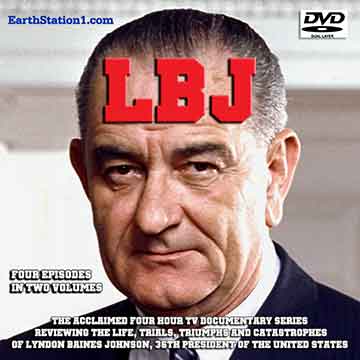
August 6, 1965: Civil Rights Movements:
The American Civil Rights Movement (1954-1968): Anti-Black Racism
In The United States: Segregation: Racial Segregation: Black
Suffrage (Black Political Franchise, Black Franchise, Black Right
To Vote, Black Active Suffrage): The Voting Rights Act Of 1965 :
--The Voting Rights Act Of 1965, a landmark piece of federal
legislation in the United States that prohibits racial
discrimination in voting, is signed into law by President Lyndon
B. Johnson during the height of the civil rights movement, and
Congress later amended the Act five times to expand its
protections. Designed to enforce the voting rights protected by
the Fourteenth and Fifteenth Amendments to the United States
Constitution, the Act suspended literacy, knowledge and character
tests designed to keep African Americans from voting in the South,
and sought to secure the right to vote for racial minorities
throughout the country, especially in the South. It also
authorized the appointment of federal voting examiners and barred
discriminatory poll taxes. According to the U.S. Department of
Justice, the Act is considered to be the most effective piece of
federal civil rights legislation ever enacted in the country. The
National Archives and Records Administration stated: "The
Voting Rights Act of 1965 was the most significant statutory
change in the relationship between the federal and state
governments in the area of voting since the Reconstruction period
following the Civil War". The act contains numerous
provisions that regulate elections. The act's "general
provisions" provide nationwide protections for voting rights.
Section 2 is a general provision that prohibits state and local
government from imposing any voting rule that "results in the
denial or abridgement of the right of any citizen to vote on
account of race or color" or membership in a language
minority group. Other general provisions specifically outlaw
literacy tests and similar devices that were historically used to
disenfranchise racial minorities. The act also contains "special
provisions" that apply to only certain jurisdictions. A core
special provision is the Section 5 preclearance requirement, which
prohibited certain jurisdictions from implementing any change
affecting voting without first receiving confirmation from the
U.S. attorney general or the U.S. District Court for D.C. that the
change does not discriminate against protected minorities. Another
special provision requires jurisdictions containing significant
language minority populations to provide bilingual ballots and
other election materials. Section 5 and most other special
provisions applied to jurisdictions encompassed by the "coverage
formula" prescribed in Section 4(b). The coverage formula was
originally designed to encompass jurisdictions that engaged in
egregious voting discrimination in 1965, and Congress updated the
formula in 1970 and 1975. In Shelby County v. Holder (2013), the
U.S. Supreme Court struck down the coverage formula as
unconstitutional, reasoning that it was obsolete. The court did
not strike down Section 5, but without a coverage formula, Section
5 is unenforceable. The jurisdictions which had previously been
covered by the coverage formula massively increased the rate of
voter registration purges after the Shelby decision. In 2021, the
Brnovich v. Democratic National Committee Supreme Court ruling
reinterpreted Section 2 of the Voting Rights Act of 1965,
substantially weakening it. The ruling interpreted the "totality
of circumstances" language of Section 2 to mean that it does
not generally prohibit voting rules that have disparate impact on
the groups that it sought to protect, including a rule blocked
under Section 5 before the Court inactivated that section in
Shelby County v. Holder. In particular, the ruling held that fears
of election fraud could justify such rules, even without evidence
that any such fraud had occurred in the past or that the new rule
would make elections safer. Research shows that the Act had
successfully and massively increased voter turnout and voter
registrations, in particular among black people. The Act has also
been linked to concrete outcomes, such as greater public goods
provision (such as public education) for areas with higher black
population shares, more members of Congress who vote for civil
rights-related legislation, and greater Black representation in
local offices. On Sale Until Midnight Tonight PT!
https://store.earthstation1.com/lbj-1991-tv-documentary-series-lyndon-johnson-dvd-download-usb-d1991.html
Today's
EarthStation1.com 15% (Or More!) Off Commemorative Memorial Title:
The American Adventure: TV History Series 1607-1876 DVD MP4 USB
Drive
Today, August 6, 2026
August 6, 1787: The United States: The
History Of The United States: The Constitution Of The United
States: The Constitutional Convention (The Philadelphia
Convention, The Federal Convention, The Grand Convention At
Philadelphia): -- Sixty proof sheets of the Constitution Of The
United States, written by The Committee Of Detail that the
Constitutional Convention established to draft a text of their
agreements since they began on May 25, are delivered to the
convention in Philadelphia, Pennsylvania. What followed for four
months of what became known as The Great Debate, recorded in James
Madison's "Notes Of Debates Of The Federal Convention Of
1787", with the ultimate result that much of what was present
in this draft was contained in the final document. Several broad
outlines had been proposed and debated, most notably James
Madison's Virginia Plan and William Paterson's New Jersey Plan.
The Virginia Plan was selected as the basis for the new
government, and the delegates quickly reached consensus on a
general blueprint of a federal government with three branches
(legislative, executive, and judicial) along with the basic role
of each branch. However, disagreement over the specific design and
powers of the branches delayed progress for weeks and threatened
the success of the convention. The most contentious disputes
involved the legislature, specifically the composition and
election procedures for the Senate as the upper legislative house
of a bicameral Congress; and whether proportional representation
was to be defined by a state's geography or by its population. The
role of the executive was also hotly debated, including the key
issues of whether to divide the executive power among three people
or vest the power in a single chief executive to be called the
President; how a president would be elected; the length of a
presidential term and the number of allowable terms; what offenses
should be impeachable; and whether judges should be chosen by the
legislature or the executive. Finally, slavery was also a
contentious issue, with the delegates debating the insertion of a
fugitive slave clause; whether to allow the abolition of the slave
trade; and whether slaves were to be counted in proportional
representation. Most of the time during the convention was spent
on deciding these issues. Outcomes included the establishment of a
four year term of office for the President, granting Congress the
right to regulate foreign trade and interstate commerce, and the
appointment of a committee to prepare a final draft of the
Constitution. On Sale Until Midnight Tonight PT!
https://store.earthstation1.com/the-american-adventure-series-us-1st-century-4-dv14.html
Today's
EarthStation1.com 15% (Or More!) Off Commemorative Memorial Title:
The Indomitable Teddy Roosevelt w/ George C Scott DVD, Download,
USB
Today, August 6, 2026
August 6, 1912: Elections: Elections In
The United States: The 1912 United States Presidential Election:
The 1912 United States Progressive National Convention (The 1912
Bull Moose Convention): -- The Progressive Party (The Bull Moose
Party): The newly established Progressive Party, popularly known
as Bull Moose Party, opens and closes The 1912 Progressive
National Convention at the Chicago Coliseum in Chicago, Illinois.
Angered at the renomination of President William Howard Taft over
their candidate at the 1912 Republican National Convention,
supporters of former President Theodore Roosevelt convened in
Chicago and endorsed the formation of a national progressive
party. When formally launched later that summer, the new
Progressive Party acclaimed Roosevelt as its presidential nominee
and Governor Hiram Johnson of California as his vice presidential
running mate. When questioned by reporters, Roosevelt said he felt
as strong as a "bull moose". Henceforth known as the
"Bull Moose Party", the Progressives promised to
increase federal regulation and protect the welfare of ordinary
people. The party was funded by publisher Frank Munsey and its
executive secretary George Walbridge Perkins, an employee of
banker J. P. Morgan and International Harvester. Perkins blocked
an antitrust plank, shocking reformers who thought of Roosevelt as
a true trust-buster. The delegates to the convention sang the hymn
"Onward, Christian Soldiers" as their anthem. In a
famous acceptance speech, Roosevelt compared the coming
presidential campaign to the Battle of Armageddon and stated that
the Progressives were going to "battle for the Lord."
The August convention opened with great enthusiasm. Over 2,000
delegates attended, including many women. In 1912, neither the
Republican candidate, President Taft, nor the Democratic nominee
Woodrow Wilson, had endorsed women's suffrage on the national
level and the famed suffragette and social worker Jane Addams gave
a seconding speech for Roosevelt's nomination. Although Roosevelt
did include black delegates from all over the country, he insisted
on excluding African American Republicans from the South, whom he
regarded as a corrupt and ineffective element, and he further
alienated white southern supporters on the eve of the election by
publicly dining with black people at a Rhode Island hotel. On Sale
Until Midnight Tonight PT!
https://store.earthstation1.com/the-indomitable-teddy-roosevelt-george-c-scott-john-philip-sousa-dvd.html
Today's
EarthStation1.com 15% (Or More!) Off Commemorative Memorial Title:
The Guns Of August (1964) WWI Film DVD, Video Download, USB Drive
Today, August 6, 2026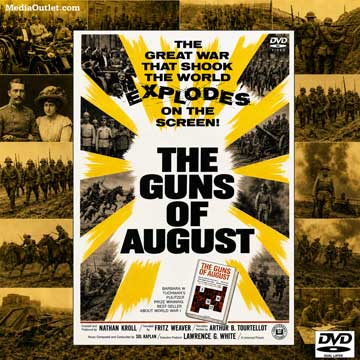
August 6, 1914: Causes Of The European
Civil War (Events Leading To The European Civil War): Causes Of
World War I (Events Leading To World War I): The Guns Of August:
The July Crisis: The Kingdom Of Serbia's Declaration Of War On The
German Empire: -- Serbia declares war on Germany,
Austria-Hungary's ally, who had declared war on Serbia the prior
July 28th. Serbia won the first major battles of the war,
including the Battle of Cer, and the Battle of Kolubara. Despite
initial success, it was eventually overpowered by the Central
Powers in 1915 and Austro-Hungarian occupation of Serbia followed.
Most of its army and some people retreated to Greece and Corfu,
suffering immense losses on the way. After the Central Powers'
military situation on other fronts worsened, the remains of the
Serb army returned east and led a final breakthrough through enemy
lines on 15 September 1918, liberating Serbia and defeating
Bulgaria and Austria-Hungary. Serbia, with its campaign, was a
major Balkan Entente Power which contributed significantly to the
Allied victory in the Balkans in November 1918, especially by
helping France force Bulgaria's capitulation. Serbia's casualties
accounted for 8% of the total Entente military deaths; 58%
(243,600) soldiers of the Serbian army perished in the war. The
total number of casualties is placed around 700,000, more than 16%
of Serbia's prewar size, and a majority (57%) of its overall male
population. Serbia suffered the biggest casualty rate in World War
I. The assassination of Austrian Archduke Ferdinand on June 28,
1914 led to a month of diplomatic manoeuvring between
Austria-Hungary, Germany, Russia, France and Britain, called the
July Crisis. Austria-Hungary correctly believed that Serbian
officials (especially the officers of the Black Hand) were
involved in the plot to murder the Archduke, and wanted to finally
end Serbian interference in Bosnia. On July 23, Austria-Hungary
delivered to Serbia the July Ultimatum, a series of ten demands
that were made intentionally unacceptable, in an effort to provoke
a war with Serbia. Serbia decreed general mobilisation on the
25th. Serbia accepted all of the terms of the ultimatum except for
article six, which demanded that Austrian delegates be allowed in
Serbia for the purpose of participation in the investigation into
the assassination. Following this, Austria broke off diplomatic
relations with Serbia and, the next day, ordered a partial
mobilisation. Finally, on July 28, 1914, Austria-Hungary declared
war on Serbia. On July 29, Russia, in support of Serbia, declared
partial mobilisation against Austria-Hungary. On the 30th, Russia
ordered general mobilisation. German Chancellor Bethmann-Hollweg
waited until the 31st for an appropriate response, when Germany
declared a "state of danger of war". Kaiser Wilhelm II
asked his cousin, Tsar Nicolas II, to suspend the Russian general
mobilisation. When he refused, Germany issued an ultimatum
demanding its mobilisation be stopped, and a commitment not to
support Serbia. Another was sent to France, asking her not to
support Russia if it were to come to the defence of Serbia. On
August 1, after the Russian response, Germany mobilised and
declared war on Russia. This also led to the general mobilisation
in Austria-Hungary on August 4. The German government issued
demands to France that it remain neutral as they had to decide
which deployment plan to implement, it being difficult if not
impossible to change the deployment whilst it was underway. The
modified German Schlieffen Plan, Aufmarsch II West, would deploy
80% of the army in the west, and Aufmarsch I Ost and Aufmarsch II
Ost would deploy 60% in the west and 40% in the east as this was
the maximum that the East Prussian railway infrastructure could
carry. The French did not respond, but sent a mixed message by
ordering their troops to withdraw 10 km (6 mi) from the border to
avoid any incidents, and at the same time ordered the mobilisation
of her reserves. Germany responded by mobilising its own reserves
and implementing Aufmarsch II West. On August 1, Wilhelm ordered
General Moltke to "march the whole of the _ army to the East"
after he had been wrongly informed that the British would remain
neutral as long as France was not attacked. The General convinced
the Kaiser that improvising the redeployment of a million men was
unthinkable and that making it possible for the French to attack
the Germans "in the rear" might prove disastrous. Yet
Wilhelm insisted that the German army should not march into
Luxembourg until he received a telegram sent by his cousin George
V, who made it clear that there had been a misunderstanding.
Eventually the Kaiser told Moltke, "Now you can do what you
want." Germany attacked Luxembourg on August 2, and on August
3 declared war on France. On August 4, after Belgium refused to
permit German troops to cross its borders into France, Germany
declared war on Belgium as well. Britain declared war on Germany
at 19:00 UTC on August 4, 1914 (effective from 11 pm), following
an "unsatisfactory reply" to the British ultimatum that
Belgium must be kept neutral. On Sale Until Midnight Tonight PT!
https://store.earthstation1.com/the-guns-of-august-dvd-1964-world-war-i-movie-documen1964.html
Today's
EarthStation1.com 15% (Or More!) Off Commemorative Memorial Title:
World War 1 TV Series With Robert Ryan DVD, Video Download, USB
Drive
Today, August 6, 2026
August 6, 1914: Causes Of The European
Civil War (Events Leading To The European Civil War): Causes Of
World War I (Events Leading To World War I): The Guns Of August:
The July Crisis: Austro-Hungarian Entry Into World War I: The
Austro-Hungarian Empire's Declaration Of War On The Russian
Empire: -- Austria declares war on Russia. The prior July 28th,
Austria-Hungary declared war on Serbia. Within days, long-standing
mobilization plans went into effect to initiate invasions or guard
against them and Russia, France and Britain stood arrayed against
Austria and Germany. Austria thought in terms of one small limited
war involving just the two countries. It did not plan a wider war
such as exploded in a matter of days. The British historian John
Zametica argued that Austria-Hungary was primarily responsible for
starting the war, as its leaders believed that a successful war
against Serbia was the only way it could remain a Great Power,
solve deep internal disputes caused by Hungarian demands and
regain influence in the Balkan states. Others, most notably
Christopher Clark, have argued that Austria-Hungary, confronted
with a neighbor determined to incite continual unrest and
ultimately acquire all of the Serb-inhabited lands of the empire
(according to the Pan-Serb point of view, they included all of
Croatia, Dalmatia, Bosnia, Hercegovina and some of the southern
counties of the Hungary (roughly corresponding to today's
Vojvodina)) and had a military and government that were
intertwined with the irredentist terrorist group known as "The
Black Hand", saw no practical alternative to the use of force
in ending what amounted to subversion from Serbia directed at a
large chunk of its territories. In that perspective, Austria had
little choice but to credibly threaten war and force Serbian
submission if it wished to remain a Great Power. The view of the
key figures in the "war party" in the Tsarist government
and many military leaders in Russia that Germany had deliberately
incited Austria-Hungary to attack Serbia to have a pretext for war
with Russia and France, was promoted by the German historian Fritz
Fischer from the 1960s onwards but is no longer accepted by
mainstream historians. One of the key drivers of the outbreak of
war were two key misperceptions that were radically at odds. The
key German decision-makers convinced themselves that Russia would
accept an Austrian counter-strike on Serbia and were neither ready
for nor seeking a general European war, but they instead engaged
in a bluff, especially because Russia had backed down in earlier
crises in 1908 and again over Albania in October 1913. At the very
same time, the most important Russian decision-makers viewed any
decisive Austrian response as necessarily dictated by and fomented
in Berlin and therefore proof of an active German desire for war
against Russia. There had been no serious joint planning with
Germany before the war started and little during the war itself,
as leaders in Vienna distrusted German ambitions. ========= The
assassination of Austrian Archduke Ferdinand on June 28, 1914 led
to a month of diplomatic manoeuvring between Austria-Hungary,
Germany, Russia, France and Britain, called the July Crisis.
Austria-Hungary correctly believed that Serbian officials
(especially the officers of the Black Hand) were involved in the
plot to murder the Archduke, and wanted to finally end Serbian
interference in Bosnia. On July 23, Austria-Hungary delivered to
Serbia the July Ultimatum, a series of ten demands that were made
intentionally unacceptable, in an effort to provoke a war with
Serbia. Serbia decreed general mobilisation on the 25th. Serbia
accepted all of the terms of the ultimatum except for article six,
which demanded that Austrian delegates be allowed in Serbia for
the purpose of participation in the investigation into the
assassination. Following this, Austria broke off diplomatic
relations with Serbia and, the next day, ordered a partial
mobilisation. Finally, on July 28, 1914, Austria-Hungary declared
war on Serbia. On July 29, Russia, in support of Serbia, declared
partial mobilisation against Austria-Hungary. On the 30th, Russia
ordered general mobilisation. German Chancellor Bethmann-Hollweg
waited until the 31st for an appropriate response, when Germany
declared a "state of danger of war". Kaiser Wilhelm II
asked his cousin, Tsar Nicolas II, to suspend the Russian general
mobilisation. When he refused, Germany issued an ultimatum
demanding its mobilisation be stopped, and a commitment not to
support Serbia. Another was sent to France, asking her not to
support Russia if it were to come to the defence of Serbia. On
August 1, after the Russian response, Germany mobilised and
declared war on Russia. This also led to the general mobilisation
in Austria-Hungary on August 4. The German government issued
demands to France that it remain neutral as they had to decide
which deployment plan to implement, it being difficult if not
impossible to change the deployment whilst it was underway. The
modified German Schlieffen Plan, Aufmarsch II West, would deploy
80% of the army in the west, and Aufmarsch I Ost and Aufmarsch II
Ost would deploy 60% in the west and 40% in the east as this was
the maximum that the East Prussian railway infrastructure could
carry. The French did not respond, but sent a mixed message by
ordering their troops to withdraw 10 km (6 mi) from the border to
avoid any incidents, and at the same time ordered the mobilisation
of her reserves. Germany responded by mobilising its own reserves
and implementing Aufmarsch II West. On August 1, Wilhelm ordered
General Moltke to "march the whole of the _ army to the East"
after he had been wrongly informed that the British would remain
neutral as long as France was not attacked. The General convinced
the Kaiser that improvising the redeployment of a million men was
unthinkable and that making it possible for the French to attack
the Germans "in the rear" might prove disastrous. Yet
Wilhelm insisted that the German army should not march into
Luxembourg until he received a telegram sent by his cousin George
V, who made it clear that there had been a misunderstanding.
Eventually the Kaiser told Moltke, "Now you can do what you
want." Germany attacked Luxembourg on August 2, and on August
3 declared war on France. On August 4, after Belgium refused to
permit German troops to cross its borders into France, Germany
declared war on Belgium as well. Britain declared war on Germany
at 19:00 UTC on August 4, 1914 (effective from 11 pm), following
an "unsatisfactory reply" to the British ultimatum that
Belgium must be kept neutral. On Sale Until Midnight Tonight PT!
https://store.earthstation1.com/world-war-1-robert-ryan-4-dual-layer-dvds-26-episode-tv-se1426.html
Today's
EarthStation1.com 15% (Or More!) Off Commemorative Memorial Title:
The Great War (1964) TV Documentary Series DVD, Video Download,
USB
Today, August 6, 2026
August 6, 1915: The European Civil War:
World War I: The First European War (The European Theater Of World
War I): The African Theatre Of World War I: The Middle Eastern
Theater Of World War I: The Battle Of Gallipoli (The Gallipoli
Campaign, The Dardanelles Campaign, The Defense Of Gallipoli): The
Battle Of Sari Bair (Turkish: Sari Bayir Harekati) (The August
Offensive [Turkish: Agustos Taarruzlari]): -- The Allies mount a
diversionary attack timed to coincide with a major Allied landing
of reinforcements at Suvla Bay. The Battle of Sari Bair (Turkish:
Sari Bayir Harekati), also known as the August Offensive (Turkish:
Agustos Taarruzlari), was the final attempt made by the British in
August 1915 to seize control of the Gallipoli peninsula from the
Ottoman Empire during the First World War. The Battle Of Sari Bair
(Turkish: Sari Bayir Harekati) represented the final attempt made
by the British in August 1915 to seize control of the Gallipoli
peninsula from the Ottoman Empire during the First World War. At
the time of the battle, the Gallipoli Campaign had raged on two
fronts - Anzac and Helles - for three months since the Allied land
invasion of 25 April 1915. With the Anzac front locked in a tense
stalemate, the Allies had attempted to carry the offensive on the
Helles battlefield - at enormous cost and for little gain. In
August, the British command proposed a new operation to
reinvigorate the campaign by capturing the Sari Bair ridge, the
high ground that dominated the middle of the Gallipoli peninsula
above the Anzac landing. The main operation started on 6 August
with a fresh landing 5 miles (8.0 km) north of Anzac at Suvla Bay
in conjunction with the Australian and New Zealand Army Corps. The
Allies mounted an attack north into the rugged country alongside
the Sari Bair range with the aim of capturing the high ground and
linking with the Suvla landing. At Helles, the British and French
were now to remain largely on the defensive. On Sale Until
Midnight Tonight PT!
https://store.earthstation1.com/the-great-war-dvd-set-1964-wwi-tv-series-26-shows-1964266.html
Today's
EarthStation1.com 15% (Or More!) Off Commemorative Memorial Title:
The Struggles For Poland TV Series + Bonus MP4 Video Download DVD
Set
Today, August 6, 2026
August 6, 1944: The European Civil War:
World War II: The Second European War (The European Theater Of
World War II): The Eastern Front Of World War II: The Polish
Resistance Movement In World War II: Operation Tempest (Polish:
Akcja Burza, "Operation Storm"): The Warsaw Uprising:
(Polish: Powstanie Warszawskie; German: Warschauer Aufstand) (The
August Uprising [Polish: Powstanie Sierpniowe]): -- The Warsaw
Uprising that began on August 1 continues until October 2. It is
brutally suppressed and all able-bodied men in Krakow are detained
afterwards to prevent a similar uprising, the Krakow Uprising,
that was planned but never carried out. On August 1, 1944, The
Warsaw Uprising began as the Polish Home Army, numbering about
40,000 Polish patriots, began shooting at Germans in the streets.
The Nazis then sent eight divisions to battle the Poles, who had
hoped for, but did not receive, assistance from the Allies. Two
months later, the rebellion was quashed. Not to be confused with
the Warsaw Ghetto Uprising or a Battle Of Warsaw, the Warsaw
Uprising was a major World War II operation by the Polish
underground resistance, led by the Home Army (Polish: Armia
Krajowa), to liberate Warsaw from German occupation. The uprising
was timed to coincide with the retreat of the German forces from
Poland ahead of the Soviet advance. While approaching the eastern
suburbs of the city, the Red Army temporarily halted combat
operations, enabling the Germans to regroup and defeat the Polish
resistance and to raze the city in reprisal. The Uprising was
fought for 63 days with little outside support. It was the single
largest military effort taken by any European resistance movement
during World War II. The Uprising began on 1 August 1944 as part
of a nationwide Operation Tempest, launched at the time of the
Soviet Lublin-Brest Offensive. The main Polish objectives were to
drive the Germans out of Warsaw while helping the Allies defeat
Germany. An additional, political goal of the Polish Underground
State was to liberate Poland's capital and assert Polish
sovereignty before the Soviet-backed Polish Committee of National
Liberation could assume control. Other immediate causes included a
threat of mass German round-ups of able-bodied Poles for
"evacuation"; calls by Radio Moscow's Polish Service for
uprising; and an emotional Polish desire for justice and revenge
against the enemy after five years of German occupation.
Initially, the Poles established control over most of central
Warsaw, but the Soviets ignored Polish attempts to maintain radio
contact with them and did not advance beyond the city limits.
Intense street fighting between the Germans and Poles continued.
By 14 September, the eastern bank of the Vistula River opposite
the Polish resistance positions was taken over by the Polish
troops fighting under the Soviet command; 1,200 men made it across
the river, but they were not reinforced by the Red Army. This, and
the lack of air support from the Soviet base five-minute flying
time away, led to allegations that Joseph Stalin tactically halted
his forces to let the operation fail, and to allow the Polish
resistance to be crushed. Arthur Koestler called the Soviet
attitude "one of the major infamies of this war which will
rank for the future historian on the same ethical level with
Lidice." Winston Churchill pleaded with Stalin and Franklin
D. Roosevelt to help Britain's Polish allies, to no avail. Then,
without Soviet air clearance, Churchill sent over 200 low-level
supply drops by the Royal Air Force, the South African Air Force,
and the Polish Air Force under British High Command, in an
operation known as the Warsaw Airlift. Later, after gaining Soviet
air clearance, the U.S. Army Air Force sent one high-level mass
airdrop as part of Operation Frantic. Although the exact number of
casualties remains unknown, it is estimated that about 16,000
members of the Polish resistance were killed and about 6,000 badly
wounded. In addition, between 150,000 and 200,000 Polish civilians
died, mostly from mass executions. Jews being harboured by Poles
were exposed by German house-to-house clearances and mass
evictions of entire neighbourhoods. German casualties totalled
over 8,000 soldiers killed and missing, and 9,000 wounded. During
the urban combat approximately 25% of Warsaw's buildings were
destroyed. Following the surrender of Polish forces, German troops
systematically levelled another 35% of the city block by block.
Together with earlier damage suffered in the 1939 Invasion Of
Poland and the Warsaw Ghetto Uprising in 1943, over 85% of the
city was destroyed by January 1945, when the course of the events
in the Eastern Front forced the Germans to abandon the city. On
Sale Until Midnight Tonight PT!
https://store.earthstation1.com/the-struggles-for-poland-dvd-set-all-9-shows-5-dis95.html
Today's
EarthStation1.com 15% (Or More!) Off Commemorative Memorial Title:
The Romantic Spirit TV Series DVD, Video Download, USB Flash Drive
Today, August 6, 2026
August 6, 1809: #BOTD: #HBD! Alfred, Lord
Tennyson, English poet, Poet Laureate during much of Queen
Victoria's reign (d. October 6, 1892) is #born in Somersby,
Lincolnshire, England. Alfred Tennyson, 1st Baron Tennyson FRS was
appointed Poet Laureate in succession to William Wordsworth; the
British Poet Laureate is an honorary position appointed by the
monarch of the United Kingdom on the advice of the Prime Minister.
The role does not entail any specific duties, but there is an
expectation that the holder will write verse for significant
national occasions. Memorable poems by Tennyson include Ode on the
Death of the Duke of Wellington and The Charge of the Light
Brigade. A number of phrases from Tennyson' work have become
commonplaces of the English language, including "Nature, red
in tooth and claw" (In Memoriam A.H.H.), "'Tis better to
have loved and lost / Than never to have loved at all",
"Theirs not to reason why, / Theirs but to do and die",
"My strength is as the strength of ten, / Because my heart is
pure", "To strive, to seek, to find, and not to yield",
"Knowledge comes, but Wisdom lingers", and "The old
order changeth, yielding place to new". Alfred, Lord Tennyson
died at Aldworth, in West Sussex, South East England, aged 83. He
was buried at Westminster Abbey, Greater London, England. His last
words were, "Oh that press will have me now!".
#AlfredTennyson #AlfredLordTennyson #PoetLaureates
#PoetLaureatesOfTheUK #Poets #Poetry #EnglishPoets #EnglishPoetry
#Romantics #Romanticism #MP4 #VideoDownload #DVD On Sale Until
Midnight Tonight PT!
https://store.earthstation1.com/the-romantic-spirit-tv-series-all-14-episodes-5-dual-layer-d145.html
Today's
EarthStation1.com 15% (Or More!) Off Commemorative Memorial Title:
The Nobel Century Nobel Prize History TV Series DVD, MP4, USB
Stick
Today, August 6, 2026
August 6, 1881: #BOTD: #HBD! Alexander
Fleming, Scottish physician, microbiologist, pharmacologist, and
botanist, Nobel Prize laureate (d. March 11, 1955) is #born in
Lochfield, Scotland. The best known discoveries of Sir Alexander
Fleming FRS FRSE FRCS are the enzyme lysozyme in 1923, and the
world's first broadly effective antibiotic substance
benzylpenicillin (Penicillin G) from the mould Penicillium Rubens
in 1928, for which he shared the Nobel Prize in Physiology or
Medicine in 1945 with Howard Florey and Ernst Boris Chain. He
wrote many articles on bacteriology, immunology, and chemotherapy.
He discovered Penicillin by accident, when he found that mold from
soil killed deadly bacteria without injuring human tissue. Fleming
was knighted for his scientific achievements in 1944. In 1999, he
was named in Time magazine's list of the 100 Most Important People
of the 20th century. In 2002, he was chosen in the BBC's
television poll for determining the 100 Greatest Britons, and in
2009, he was also voted third "greatest Scot" in an
opinion poll conducted by STV, behind only Robert Burns and
William Wallace. Alexander Fleming died at his home in London,
England of a heart attack at the age of 73. His ashes are buried
in St Paul's Cathedral. On Sale Until Midnight Tonight PT!
https://store.earthstation1.com/the-nobel-century-nobel-prize-history-tv-series-dvd-mp4-us4.html
Today's
EarthStation1.com 15% (Or More!) Off Commemorative Memorial Title:
Field Marshal William Slim Documentaries DVD, Download, USB Drive
Today, August 6, 2026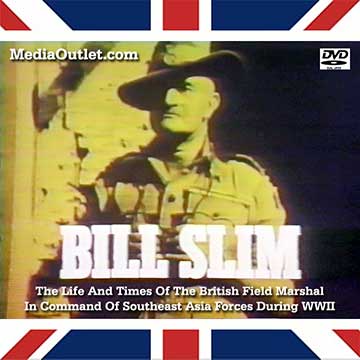
August 6, 1891: #BOTD: #HBD! William
Slim, 1st Viscount Slim, English field marshal and politician,
13th Governor-General of Australia (d. December 14, 1970) is #born
William Joseph Slim at 72 Belmont Road, St Andrews, Bristol,
England. Slim saw active service in both the First and Second
world wars and was wounded in action three times. During the
Second World War he led the 14th Army, the so-called "forgotten
army" in the Burma campaign. After the war he became the
first British officer who had served in the Indian Army to be
appointed Chief of the Imperial General Staff. From 1953 to 1959
he was Governor-General of Australia and is regarded by many
Australians as an authentic war hero who had fought with the
Anzacs at Gallipoli. In the early 1930s, Slim also wrote novels,
short stories, and other publications under the pen name Anthony
Mills. William Slim died in London, England aged 79 and was given
a full military funeral at St. George's Chapel in Windsor Castle
and was afterwards cremated. He ashes are interred at Saint Paul's
Cathedral in London, England. On Sale Until Midnight Tonight PT!
https://store.earthstation1.com/slim-dvd-field-marshal-william-bill-dual-layer-wwii.html
Today's
EarthStation1.com 15% (Or More!) Off Commemorative Memorial Title:
The Weapons Of Desert Shield + Bonus Persian Gulf War DVD MP4
Download
Today, August 6, 2026
August 6, 1990: The Aftermath Of World
War II: The Cold War: The Gulf War (The Persian Gulf War, Gulf War
I): The Invasion Of Kuwait: Operation Desert Shield: -- United
States Secretary Of Defense Dick Cheney meets King Fahd Of Saudi
Arabia in Riyadh to discuss sending U.S. military troops to defend
Saudi Arabia in case of an Iraqi invasion. On August 2, 1990, the
Invasion Of Kuwait by Iraq began shortly after midnight local
time, when about 100,000 Iraqi troops invaded Kuwait amid claims
that Kuwait threatened Iraq's economic existence by overproducing
oil and driving prices down on the world market. Also on August 2,
1990, United Nations Security Council Resolution 660 was issued by
he United Nations Security Council (UNSC) condemning the Iraqi
Invasion Of Kuwait and demanding that Iraq withdraw immediately
and unconditionally to positions as they were on August 1, 1990.
It was the first of twelve resolutions on the conflict passed in
1990. On July 31, Egypt and Saudi Arabia attempted to mediate
between the two countries with a meeting on meeting between Iraq
and Kuwait in Jeddah, Saudi Arabia. Iraq clearly stated on this
occasion that it would not use armed forces against neighboring
countries. However, at dawn on August 2, the Iraqi army that was
amassed near the border suddenly invaded Kuwait. On July 24, 1990,
President of Egypt Hosni Mubarak traveled to Baghdad to meet with
Saddam Hussein and discuss the dispute between Kuwait and Iraq, to
no avail. On July 22, 1990, Iraq began deploying troops to the
Iraqi-Kuwaiti border, creating a massive military buildup in
preparation for what would become the Iraqi Invasion Of Kuwait,
which ultimately resultd in the Gulf War (Gulf War I). Iraq
accused Kuwait onn July 15, 1990 of stealing oil from the Rumaila
oil field, an Iraqi oil field near the Iraqi-Kuwaiti border, and
threatened military action in response. In 1988 Iraq's Oil
Minister, Issam al-Chalabi, stressed a further reduction in the
crude oil production quota of Organization of the Petroleum
Exporting Countries (OPEC) members so as to end the 1980s oil
glut. Chalabi argued that higher oil prices would help Iraq
increase its revenues and pay back its 60B USD debt. However,
given its large downstream petroleum industry, Kuwait was less
concerned about the prices of crude oil and in 1989, Kuwait
requested OPEC to increase the country's total oil production
ceiling by 50% to 1.35 million bpd. Throughout much of the 1980s,
Kuwait's oil production was considerably above its mandatory OPEC
quota and this had prevented a further increase in crude oil
prices. A lack of consensus among OPEC members undermined Iraq's
efforts to end the oil glut and consequently prevented the
recovery of its war-crippled economy. According to former Iraqi
Foreign Minister Tariq Aziz, "every 1 USD drop in the price
of a barrel of oil caused a 1B USD drop in Iraq's annual revenues
triggering an acute financial crisis in Baghdad". Kuwait's
refusal to decrease its oil production was viewed by Iraq as an
act of aggression against it. The increasingly tense relations
between Iraq and Kuwait were further aggravated when Iraq alleged
that Kuwait was slant-drilling across the border into Iraq's
Rumaila field. The dispute over Rumaila field started in 1960 when
an Arab League declaration marked the Iraq-Kuwait border 2 miles
north of the southernmost tip of the Rumaila field. During the
Iran-Iraq War, Iraqi oil drilling operations in Rumaila declined
while Kuwait's operations increased. In 1989, Iraq accused Kuwait
of using "advanced drilling techniques" to exploit oil
from its share of the Rumaila field. Iraq estimated that 2.4B USD
worth of Iraqi oil was "stolen" by Kuwait and demanded
compensation. Kuwait dismissed the accusations as a false Iraqi
ploy to justify military action against it. Several foreign firms
working in the Rumaila field also dismissed Iraq's slant-drilling
claims as a "smokescreen to disguise Iraq's more ambitious
intentions". On July 25, 1990, only a few days before the
Iraqi invasion, OPEC officials said that Kuwait and the United
Arab Emirates had agreed to a proposal to limit daily oil output
to 1.5 million barrels, thus potentially settling differences over
oil policy between Kuwait and Iraq. At the time of the settlement,
more than 100,000 Iraqi troops were deployed along the Iraq-Kuwait
border, and American officials expressed little indication of
decline in tensions despite the OPEC settlement. On Sale Until
Midnight Tonight PT!
https://store.earthstation1.com/the-weapons-of-desert-shield-persian-gulf-war-i-dvd-mp4-download-us4.html
Today's
EarthStation1.com 15% (Or More!) Off Commemorative Memorial Title:
The Gulf Crisis: The Road To War TV Series + Bonus 2 DVDs MP4
Download
Today, August 6, 2026
August 6, 1990: The Aftermath Of World
War II: The Cold War: The Gulf War (The Persian Gulf War, Gulf War
I): The Invasion Of Kuwait: -- United Nations Security Council
Resolution 661 (UNSCR661) implements international sanctions on
Iraq that results in a global trade embargo against Iraq in
response to Iraq' Invasion Of Kuwait. Yemen doesn't take part in
the vote in the UNSC. On August 2, 1990, the Invasion Of Kuwait by
Iraq began shortly after midnight local time, when about 100,000
Iraqi troops invaded Kuwait amid claims that Kuwait threatened
Iraq's economic existence by overproducing oil and driving prices
down on the world market. Also on August 2, 1990, United Nations
Security Council Resolution 660 was issued by he United Nations
Security Council (UNSC) condemning the Iraqi Invasion Of Kuwait
and demanding that Iraq withdraw immediately and unconditionally
to positions as they were on August 1, 1990. It was the first of
twelve resolutions on the conflict passed in 1990. On July 31,
Egypt and Saudi Arabia attempted to mediate between the two
countries with a meeting on meeting between Iraq and Kuwait in
Jeddah, Saudi Arabia. Iraq clearly stated on this occasion that it
would not use armed forces against neighboring countries. However,
at dawn on August 2, the Iraqi army that was amassed near the
border suddenly invaded Kuwait. On July 24, 1990, President of
Egypt Hosni Mubarak traveled to Baghdad to meet with Saddam
Hussein and discuss the dispute between Kuwait and Iraq, to no
avail. On July 22, 1990, Iraq began deploying troops to the
Iraqi-Kuwaiti border, creating a massive military buildup in
preparation for what would become the Iraqi Invasion Of Kuwait,
which ultimately resultd in the Gulf War (Gulf War I). Iraq
accused Kuwait onn July 15, 1990 of stealing oil from the Rumaila
oil field, an Iraqi oil field near the Iraqi-Kuwaiti border, and
threatened military action in response. In 1988 Iraq's Oil
Minister, Issam al-Chalabi, stressed a further reduction in the
crude oil production quota of Organization of the Petroleum
Exporting Countries (OPEC) members so as to end the 1980s oil
glut. Chalabi argued that higher oil prices would help Iraq
increase its revenues and pay back its 60B USD debt. However,
given its large downstream petroleum industry, Kuwait was less
concerned about the prices of crude oil and in 1989, Kuwait
requested OPEC to increase the country's total oil production
ceiling by 50% to 1.35 million bpd. Throughout much of the 1980s,
Kuwait's oil production was considerably above its mandatory OPEC
quota and this had prevented a further increase in crude oil
prices. A lack of consensus among OPEC members undermined Iraq's
efforts to end the oil glut and consequently prevented the
recovery of its war-crippled economy. According to former Iraqi
Foreign Minister Tariq Aziz, "every 1 USD drop in the price
of a barrel of oil caused a 1B USD drop in Iraq's annual revenues
triggering an acute financial crisis in Baghdad". Kuwait's
refusal to decrease its oil production was viewed by Iraq as an
act of aggression against it. The increasingly tense relations
between Iraq and Kuwait were further aggravated when Iraq alleged
that Kuwait was slant-drilling across the border into Iraq's
Rumaila field. The dispute over Rumaila field started in 1960 when
an Arab League declaration marked the Iraq-Kuwait border 2 miles
north of the southernmost tip of the Rumaila field. During the
Iran-Iraq War, Iraqi oil drilling operations in Rumaila declined
while Kuwait's operations increased. In 1989, Iraq accused Kuwait
of using "advanced drilling techniques" to exploit oil
from its share of the Rumaila field. Iraq estimated that 2.4B USD
worth of Iraqi oil was "stolen" by Kuwait and demanded
compensation. Kuwait dismissed the accusations as a false Iraqi
ploy to justify military action against it. Several foreign firms
working in the Rumaila field also dismissed Iraq's slant-drilling
claims as a "smokescreen to disguise Iraq's more ambitious
intentions". On July 25, 1990, only a few days before the
Iraqi invasion, OPEC officials said that Kuwait and the United
Arab Emirates had agreed to a proposal to limit daily oil output
to 1.5 million barrels, thus potentially settling differences over
oil policy between Kuwait and Iraq. At the time of the settlement,
more than 100,000 Iraqi troops were deployed along the Iraq-Kuwait
border, and American officials expressed little indication of
decline in tensions despite the OPEC settlement. On Sale Until
Midnight Tonight PT!
https://store.earthstation1.com/the-gulf-crisis-the-road-to-war-tv-documentary-series-dvd-mp4-us4.html
Today's
EarthStation1.com 15% (Or More!) Off Commemorative Memorial Title:
The Soviet-Afghan War DVD, MP4 Video Download, USB Flash Drive
Today, August 6, 2026
August 6, 1947: #BOTD: #HBD! Mohammad
Najibullah, commonly known as Najibullah or Dr. Najib, Afghan
physician and politician, 7th President of Afghanistan (d.
September 27, 1996) is #born Mohammad Najibullah Ahmadzai in the
city of Gardez, Paktia Province, in the Kingdom of Afghanistan. A
graduate of Kabul University, Najibullah held different careers
under the People's Democratic Party of Afghanistan (PDPA).
Following the Saur Revolution and the establishment of the
Democratic Republic of Afghanistan, Najibullah was a low profile
bureaucrat: he was sent into exile as Ambassador to Iran during
Hafizullah Amin's rise to power. He returned to Afghanistan
following the Soviet intervention which toppled Amin's rule and
placed Babrak Karmal as head of state, party and government.
During Karmal's rule, Najibullah became head of the KHAD, the
Afghan equivalent of the Soviet KGB. He was a member of the
Parcham faction led by Karmal. During Najibullah's tenure as KHAD
head, it became one of the most brutally efficient governmental
organs. Because of this, he gained the attention of several
leading Soviet officials, such as Yuri Andropov, Dmitriy Ustinov
and Boris Ponomarev. In 1981, Najibullah was appointed to the PDPA
Politburo. In 1985 Najibullah stepped down as state security
minister to focus on PDPA politics; he had been appointed to the
PDPA Secretariat. Mikhail Gorbachev, the last Soviet leader, was
able to get Karmal to step down as PDPA General Secretary in 1986,
and replace him with Najibullah. For a number of months Najibullah
was locked in a power struggle against Karmal, who still retained
his post of Chairman of the Revolutionary Council. Najibullah
accused Karmal of trying to wreck his policy of National
Reconciliation, which were a series of efforts by Najibullah to
end the conflict. Mohammad Najibullah Ahmadzai was the President
of Afghanistan from 1987 until his resignation in April 1992,
shortly after which the mujahideen took over Kabul. During his
tenure as leader of Afghanistan, the Soviets began their
withdrawal, and from 1989 until 1992, his government tried to
solve the ongoing civil war without Soviet troops on the ground.
While direct Soviet assistance ended with the withdrawal, the
Soviet Union still supported Najibullah with economic and military
aid, while Pakistan and the United States continued its support
for the mujahideen. Throughout his tenure, he tried to build
support for his government via the National Reconciliation reforms
by distancing from socialism in favor of Afghan nationalism,
abolishing the one-party state and letting non-communists join the
government. He remained open to dialogue with the mujahideen and
other groups, made Islam an official religion, and invited exiled
businessmen back to re-take their properties. In the 1990
constitution all references to communism were removed and Islam
became the state religion. For various reasons such changes did
not win Najibullah any significant support. With the Dissolution
Of The Soviet Union in December 1991, Najibullah was left without
foreign aid. This, coupled with the internal collapse of his
government, led to his resignation in April 1992. After a failed
attempt to flee to India, Najibullah remained in Kabul living in
the United Nations headquarters until his death at the hands of
the Taliban after their capture of the city. On September 27,
1996, Mohammad Najibullah was tortured and murdered by the
Taliban. Although feared at the time as head of the intelligence,
by the 21st century public opinion turned positive and he is now
seen to have been a strong and patriotic leader with a "normal"
regime compared to his PDPA predecessors and the mayhem that
happened after his ousting. In 2017 a pro-Najibist Watan Party was
created as a continuation of Najibullah's party. On Sale Until
Midnight Tonight PT!
https://store.earthstation1.com/the-sovietafghan-war-dvd-mp4-usb-driv4.html
Today's
EarthStation1.com 15% (Or More!) Off Commemorative Memorial Title:
Castro's Cuba: Two Views/Guantanamo DVD, MP4 Download, USB Flash
Drive
Today, August 6, 2026
August 6, 1960: Cuba: The History Of
Cuba: The Aftermath Of World War II: The Cold War: The Cuban Cold
War: The Cuban Revolution: The Cuban Nationalization Of U.S. Owned
Property: -- In February 1959, the Ministry for the Recovery of
Misappropriated Assets (Ministerio de Recuperacion de Bienes
Malversados) was created. Cuba began expropriating land and
private property under the auspices of the Agrarian Reform Law of
17 May 1959. Farms of any size could be and were seized by the
government, while land, businesses, and companies owned by upper-
and middle-class Cubans were nationalized (notably, including the
plantations owned by Fidel Castro's family). By the end of 1960,
the revolutionary government had nationalized more than 25B USD
worth of private property owned by Cubans. The Castro government
formally nationalized all foreign-owned property, particularly
American holdings, in the nation on 6 August 1960. In 1961, the
Cuban government nationalized all property held by religious
organizations, including the dominant Roman Catholic Church.
Hundreds of members of the church, including a bishop, were
permanently expelled from the nation, as the new Cuban government
declared itself officially atheist. Education also saw significant
changes - private schools were banned and the progressively
socialist state assumed greater responsibility for children. The
Cuban government also began to expropriate from mafia leaders and
taking their cash. Before Meyer Lansky fled Cuba, he was said to
be worth an estimated 20M US (163M USD in 2016); when he died in
1983, his family was shocked that his estate was worth less than
10K USD. Before he died Lansky said Cuba "ruined" him.
On Sale Until Midnight Tonight PT!
https://store.earthstation1.com/castro39s-cuba-two-views-with-scott-simon-dvd-proandcon-fil39.html
Today's
EarthStation1.com 15% (Or More!) Off Commemorative Memorial Title:
The Siege Of Vicksburg American Civil War DVD MP4 Download USB
Drive
Today, August 6, 2026
August 6, 1862: The American Civil War
(The Civil War, The War Between The States): The Western Theater
Of The American Civil War: The Vicksburg Campaign: The Siege Of
Vicksburg: Naval History: The History Of The Confederate States
Navy (CSN): Ironclad Warships (Ironclads): The CSS Arkansas: --
The Confederate ironclad CSS Arkansas is scuttled on the
Mississippi River near Baton Rouge, Louisiana after suffering
catastrophic engine failure. CSS Arkansas was the lead ship of her
class of two casemate ironclads built for the Confederate States
Navy during the American Civil War. Completed in 1862, she saw
combat in the Western Theater when she steamed through a United
States Navy fleet at Vicksburg in July. Arkansas was set on fire
and destroyed by her crew after her engines broke down several
weeks later. Her remains lie under a levee above Baton Rouge,
Louisiana. On Sale Until Midnight Tonight PT!
https://store.earthstation1.com/the-siege-of-vicksburg-american-civil-war-dvd-mp4-download-usb-driv4.html
Today's
EarthStation1.com 15% (Or More!) Off Commemorative Memorial Title:
Gung Ho! 1943 Carlson's Raiders Randolph Scott DVD, Download, USB
Today, August 6, 2026
August 6, 1917: #BOTD: #HBD! Robert
Mitchum, American film actor, director, author, poet, composer,
and singer (d. July 1, 1997) is #born Robert Charles Durman
Mitchum in Bridgeport, Connecticut. Mitchum rose to prominence for
his starring roles in several classic films noir, and is generally
considered a forerunner of the antiheroes prevalent in film during
the 1950s and 1960s. His best-known films include Out of the Past
(1947), The Night of the Hunter (1955), and Cape Fear (1962).
Mitchum was nominated for the Academy Award for Best Supporting
Actor for The Story of G.I. Joe (1945). Mitchum is rated number 23
on the American Film Institute's list of the greatest male stars
of Classic American Cinema. On September 1, 1948, after a string
of successful films for RKO, Mitchum and actress Lila Leeds were
arrested for possession of marijuana. The arrest was the result of
a sting operation designed to capture other Hollywood partiers as
well, but Mitchum and Leeds did not receive the tipoff. After
serving a week at the county jail (he described the experience to
a reporter as being "like Palm Springs, but without the
riff-raff"), Mitchum spent 43 days (February 16 to March 30)
at a Castaic, California, prison farm. Life photographers were
permitted to take photos of him mopping up in his prison uniform.
The arrest inspired the exploitation film She Shoulda Said No!
(1949), which starred Leeds. The conviction was later overturned
by the Los Angeles court and district attorney's office on January
31, 1951, after being exposed as a setup. Whether despite, or
because of, Mitchum's troubles with the law and his studio, his
films released immediately after his arrest were box-office hits.
Mitchum's close friends included Jane Russell, his neighbor in
Santa Barbara, California, and Deborah Kerr, his favorite costar.
A lifelong heavy smoker, Mitchum died in his sleep at 5 a.m. in
Santa Barbara, California, from complications of lung cancer and
emphysema, aged 79. His wife of 57 years, Dorothy, was by his
side. His body was cremated and, on July 6, his ashes were
scattered into the Pacific Ocean off the coast near his home. The
private ceremony was attended by only his family members and his
longtime friend Jane Russell. There is a cenotaph to him in the
Odd Fellows Cemetery in Delaware. #RobertMitchum #Actors
#Directors #Authors #Poets #Composers #Singers #Movies #Film
#MotionPictures #Hollywood #ClassicalHollywoodCinema
#ClassicalHollywoodNarrative #ClassicHollywoodCinema
#GoldenAgeOfHollywood #OldHollywood #SilverScreen #FilmNoir
#Antiheroes #MP4 #VideoDownload #DVD On Sale Until Midnight
Tonight PT!
https://store.earthstation1.com/gung-ho-dvd-1943-randolph-scott-robert-mit1943.html
Today's
EarthStation1.com 15% (Or More!) Off Commemorative Memorial Title:
Jack Armstrong The All American Boy Radio MP3 Set DVD, Download,
USB
Today, August 6, 2026
August 6, 1915: #BOTD: #HBD! Jim Ameche,
a familiar voice actor on radio, best known for his role as
radio's original Jack Armstrong on Jack Armstrong, the
All-American Boy (d. February 4, 1983) is #born James Amici in
Kenosha, Wisconsin,. When his elder brother, the famous American
actor, voice artist and comedian Don Ameche, left his position as
the host and announcer for The Chase and Sanborn Hour in the early
1940s, Jim took over for the remainder of the show's run. He also
was heard as mountie Jim West on ABC's Silver Eagle (1951-55).
Other shows Ameche was heard on included Grand Hotel, Hollywood
Playhouse, and Big Sister. In the 1940s, he had several programs
on WGN radio in Chicago. He was heard on stations in Los Angeles
and Palm Springs in the late 1950s and early 60s. For many years
he was a popular local radio personality in the New York City
area. By the late 1960s, he was working as an announcer on New
York's WHN and the TV pitchman for a Longines Symphonette Society
mail-order record album featuring clips of old-time radio
broadcasts. In the 1960s he also read radio advertisements for
Gibson wines. For many years, he was the afternoon announcer on
WQXR, the classical radio station of The New York Times, where he
was a familiar and beloved voice. He also recorded numerous radio
ads in Phoenix, Arizona in his later years. He portrayed Alexander
Graham Bell in the 1957 film The Story of Mankind, the role his
brother Don had played in the film biography of Bell in 1939. Jim
Ameche was married to the former Betty A.Harris of Oak Park,
Illinois. The couple had six children. Alan Ameche, the
professional football player, was a cousin of Jim. Jim Ameche died
February 4, 1983, of lung cancer at Tucson Medical Center at age
67. He is buried at East Lawn Palms Cemetery And Mortuary in
Tucson, Arizona. On Sale Until Midnight Tonight PT!
https://store.earthstation1.com/jack-armstrong-mp3-cd-complete-radio-adventure-serie3.html
Today's
EarthStation1.com 15% (Or More!) Off Commemorative Memorial Title:
Medium Cool (1969) News Media & The 1968 DNC DVD, Download,
USB Drive
Today, August 6, 2026
August 6, 1938: #BOTD: #HBD! Peter Bonerz, American actor, comedian and director, best known for his role as Dr. Jerry Robinson on The Bob Newhart Show, is #born Peter Roman Bonerz in Portsmouth, New Hampshire, to Elfrieda (nee Kern) and Christopher Bonerz. He grew up in Milwaukee, Wisconsin, where he attended Marquette University High School. Here, performing with the Prep Players, he gained his first theatrical experience. At Marquette University, he participated in the Marquette University Players. After graduating with a Bachelor of Science degree in 1960, he decided to seek a career in theater, starting in New York City in improv with a troupe called The Premise. After compulsory service as a draftee in the United States Army, he worked with an improv troupe in San Francisco known as The Committee, whose members included Rob Reiner, David Ogden Stiers, Howard Hesseman and Hamilton Camp. Bonerz's first network television appearance was in 1965 on The Addams Family in the season-two episode "Morticia, The Writer". He had several more TV appearances in the late 1960s and also had roles in several films, including Funnyman (1967); What Ever Happened to Aunt Alice? (1969); Medium Cool (1969); Catch-22 (1970), which also included his future co-star Bob Newhart; Jennifer on My Mind (1971); and Fuzz (1972). In 1971, Bonerz was part of an ensemble cast in the short-lived improvisational television show Story Theatre, which also included Alan Alda and Valerie Harper. In 1972, he landed the popular supporting role of the eccentric orthodontist on The Bob Newhart Show, whose most frequent comic foil was Marcia Wallace as Carol, the sharp-tongued receptionist. Bonerz would reprise this role in a cameo appearance in the final, unaired episode of Bob Newhart's third series, Bob. He also directed 29 episodes. The show ran for six seasons, with ratings among the top 20 in the first three seasons. Bonerz became the last surviving cast member upon the death of Bob Newhart in 2024. His later acting roles included the TV miniseries The Bastard (1978) and as a psychiatrist in the movie Serial (1980). In 1979, Bonerz appeared on Password Plus as a game show contestant/celebrity guest star with Marcia Wallace, his costar from The Bob Newhart Show. In 1986, Bonerz co-starred with Tuesday Weld and River Phoenix in the television movie Circle of Violence: A Family Drama. In 1999, he played Ed. Weinberger in the movie Man on the Moon. He voiced Sal in the Aaahh!!! Real Monsters episode "Internal Affairs". In 2014, he played Doug Demarco in the "Anniversaries" episode of Parks and Recreation. Beginning in 1974, Bonerz directed 29 episodes of The Bob Newhart Show. Between 1974 and 2011, he directed over 350 episodes of various shows, including series like Murphy Brown (93 episodes), Home Improvement (29 episodes), E/R (22 episodes), Friends (12 episodes), Joey (TV series) (3 episodes), and many others such as Wings, NewsRadio, Archie Bunker's Place, and ALF. He also directed films such as Nobody's Perfekt (1981) and Police Academy 6: City Under Siege (1989). Bonerz married Rosalind DiTrapani in 1963; together they have two children, Eli and Eric. On Sale Until Midnight Tonight PT! https://store.earthstation1.com/medium-cool-dvd.html
Today's
EarthStation1.com 15% (Or More!) Off Commemorative Memorial Title:
Lady Day: The Many Faces of Billie Holiday DVD, Download, Flash
Drive
Today, August 6, 2026
August 6, 1918: #BOTD: #HBD! Norman
Granz, American-Swiss record producer and manager (d. November 22,
2001) is #born in Boyle Heights, Los Angeles, the son of Jewish
immigrants from Tiraspol, then part of the Russian Empire, now the
de facto capital of Transnistria, a breakaway state of Moldova.
Norman Granz was a fundamental figure in American jazz, especially
from about 1947 to 1960. He was the founder of five record labels:
Clef, Norgran, Down Home, Verve and Pablo. Granz was acknowledged
as "the most successful impresario in the history of jazz".
Granz is also known for his anti-racist position and for
integrating audiences. Acts associated with him include Ella
Fitzgerald, Cannonball Adderley, Louis Armstrong, Count Basie,
Louie Bellson, Ray Brown, Benny Carter, Buck Clayton, Paulinho da
Costa, Buddy DeFranco, Roy Eldridge, Duke Ellington, Herb Ellis,
Tal Farlow, Stan Getz, Dizzy Gillespie, Lionel Hampton, Bill
Harris, Coleman Hawkins, Johnny Hodges, Billie Holiday, Milt
Jackson, Illinois Jacquet, Hank Jones, Barney Kessel, Gene Krupa,
Howard McGhee, Thelonious Monk, Bill Evans, Gerry Mulligan, Anita
O'Day, Charlie Parker, Joe Pass, Oscar Peterson, Flip Phillips,
Bud Powell, Buddy Rich, Charlie Shavers, Sonny Stitt, Art Tatum,
Ben Webster, Lester Young, among many others. Granz died of cancer
on at the age of 83, in Geneva, Switzerland. Norman Granz died of
cancer at the age of 83 in Geneva, Switzerland. He is buried in
Ordrup Cemetery in Ordrup, Hovedstaden, Denmark. On Sale Until
Midnight Tonight PT!
https://store.earthstation1.com/lady-day-the-many-faces-of-billie-holiday-dvd-plus-bonus.html
Today's
EarthStation1.com 15% (Or More!) Off Commemorative Memorial Title:
Rock & Roll An Unruly History 10 Part TV Series MP4 Video
Download DVD
Today, August 6, 2026
August 6, 1996: Aesthetics: Performing
Arts: Finales: Musical Finales: Punk Rock (Punk): Farewell
Concerts: -- The Ramones played their farewell concert at The
Palace, Los Angeles, CA. The Ramones were an American punk rock
band that formed in the New York City neighborhood of Forest
Hills, Queens, in 1974. They are often cited as the first true
punk rock group. Despite only achieving limited commercial success
during their time together, the band is today seen as highly
influential. All of the band members adopted pseudonyms ending
with the surname "Ramone", although none of them were
biologically related; they were inspired by Paul McCartney, who
would check into hotels under alias "Paul Ramon". The
Ramones performed 2,263 concerts, touring virtually nonstop for 22
years. In 1996, after a tour with the Lollapalooza music festival,
they played a farewell concert in Los Angeles and disbanded. By
2014, all four of the band's original members had died - lead
singer Joey Ramone (1951-2001), bassist Dee Dee Ramone
(1951-2002), guitarist Johnny Ramone (1948-2004) and drummer Tommy
Ramone (1949-2014). Each surviving member of the Ramones - bassist
C. J. Ramone (who replaced Dee Dee in 1989 and stayed with the
band until its dissolution) and drummers Marky Ramone, Richie
Ramone and Elvis Ramone - remains musically active. Recognition of
the band's importance has built over the years. The Ramones ranked
number 26 in Rolling Stone magazine's list of the "100
Greatest Artists of All Time" and number 17 in VH1's "100
Greatest Artists of Hard Rock". In 2002, the Ramones were
ranked the second-greatest band of all time by Spin, trailing only
the Beatles. On March 18, 2002, the original four members and
Tommy's replacement on drums, Marky Ramone, were inducted into the
Rock and Roll Hall of Fame in their first year of eligibility. In
2011, the group was awarded a Grammy Lifetime Achievement Award.
On Sale Until Midnight Tonight PT!
https://store.earthstation1.com/rock-amp-roll-an-unruly-history-10-part-tv-series-mp4-video-download-104.html
Today's
EarthStation1.com 15% (Or More!) Off Commemorative Memorial Title:
Forty Years Of Fine Tuning (1984) WNEW TV Channel 5 DVD, Download,
USB
Today, August 6, 2026
August 6, 1956: Aesthetics: Performing
Arts: Finales: American Television Finales: -- After going
bankrupt in 1955, the American broadcaster DuMont Television
Network makes its final broadcast, a boxing match from St.
Nicholas Arena in New York in the Boxing from St. Nicholas Arena
series. The DuMont Television Network (also known as the DuMont
Network, DuMont Television, simply DuMont/Du Mont, or colloquially
as Dumont) was one of America's pioneer commercial television
networks, rivaling NBC and CBS for the distinction of being first
overall in the United States. It was owned by Allen B. DuMont
Laboratories, a television equipment and television set
manufacturer, and began operation on April 13, 1940. The network
was hindered by the prohibitive cost of broadcasting, a freeze on
new television stations in 1948 by the Federal Communications
Commission (FCC) that restricted the network's growth, and even
the company's partner, Paramount Pictures. Despite several
innovations in broadcasting and being the launching spot for one
of television's biggest stars of the 1950s -- Jackie Gleason --
the network never found itself on solid financial ground. Forced
to expand on UHF channels during an era when UHF tuning was not
yet a standard feature on television sets, DuMont fought an uphill
battle for program clearances outside its three owned-and-operated
stations: WABD Channel 5 in New York City (modern WNYW), WTTG
Channel 5 in Washington, D.C. (modern WTTG), and WDTV Channel 2 in
Pittsburgh (modern KDKA-TV [also known as CBS Pittsburgh]),
ultimately ending network operations on August 6, 1956, leaving
only three main networks, rather than public broadcasting, until
the founding of Fox in 1986. DuMont's latter-day obscurity, caused
mainly by the destruction of its extensive program archive by the
1970s, has prompted TV historian David Weinstein to refer to it as
the "forgotten network". A few popular DuMont programs,
such as Cavalcade of Stars and Emmy Award winner Life Is Worth
Living, appear in television retrospectives or are mentioned
briefly in books about U.S. television history. In addition, a
collection of programs and promos is available on the Roku
streaming channel under the DuMont name. On Sale Until Midnight
Tonight PT!
https://store.earthstation1.com/forty-years-of-fine-tuning-dvd-wnew-tv-channel-5-ny5.html
Today's
EarthStation1.com 15% (Or More!) Off Commemorative Memorial Title:
Hizzoner The Mayor Jimmy Walker & Fiorello La Guardia MP4
Download DVD
Today, August 6, 2026
August 6, 1930: Crime: Crime In The
United States: Disappearances (Missing Persons Cases): Crime In
New York City: The Disappearance Of Joseph Force Crater: -- Judge
Joseph Force Crater is last seen leaving Billy Haas' Chophouse at
332 West 45th Street in Manhattan and reportedly steps into a
taxi, then disappears, never to be seen again, entering popular
culture as one of the most mysterious missing persons cases of the
twentieth century. Joseph Crater was born January 5, 1889 in
Easton, Pennsylvania; he was officially declared legally dead June
6, 1939, almost nine years after his disapperance. Joseph Force
Crater was a New York State Supreme Court Justice who vanished
amid a major political scandal that ultimately resulted in the
resignation of New York City Mayor Jimmie Walker. Despite massive
publicity, the case of Judge Crater's disapperance was never
officially solved, and was closed forty years after he
disappeared. Crater's disappearance fueled public disquiet about
New York City corruption and was a factor in the downfall of the
Tammany Hall political machine. In the summer of 1930, after the
start of the first investigations of what would become one year
later the Hofstadter Committee, Crater and his wife Stella Mance
Wheeler were vacationing at their summer cabin in Belgrade, Maine.
The Hofstadter Committee, also known as the Seabury
Investigations, was a joint legislative committee formed by the
New York State Legislature on behalf of Governor Franklin D.
Roosevelt to probe into corruption in New York City, especially
the magistrate's courts and police department in 1931. It led to
major changes in the method of arrest, bail and litigation of
suspects in New York City. It also coincided with the decline in
Tammany Hall's political influence in New York State politics. In
late July, Crater received a telephone call. He offered no
information to his wife about the content of the call, other than
to say that he had to return to the city "to straighten those
fellows out". The next day, he arrived at his 40 Fifth Avenue
apartment, but instead of dealing with business, he proceeded
onwards to Atlantic City, New Jersey, with his mistress, showgirl
Sally Lou Ritzi (who used the stage name Ritz). Crater returned to
Maine on August 1, and traveled back to New York on August 3.
Before making this final trip, he promised his wife that he would
return by her birthday on August 9. Crater's wife stated that he
was in good spirits and behaving normally when he departed for New
York City. On the morning of Wednesday, August 6, Crater spent two
hours going through his files in his courthouse chambers,
reportedly destroying several documents. He then had his law clerk
Joseph Mara cash two checks for him that amounted to 5,150 USD
(equivalent to about 78,820 USD in 2019). At noon, he and Mara
carried two locked briefcases to his apartment and he let Mara
take the rest of the day off. Crater had gone to a Broadway ticket
agency, Supreme Tickets, and bought one seat from William Deutsch,
the proprietor of Supreme, for a comedy called Dancing Partner at
the Belasco Theatre. He then went to Billy Haas' Chophouse at 332
West 45th Street, where he ate dinner with his mistress Sally Lou
Ritzi and William Klein, a lawyer friend. Klein later told
investigators that Crater was in a good mood that evening and gave
no indication that anything was bothering him. The dinner ended a
little after 9 p.m., shortly after the curtain rose on the show
for which Crater had bought a ticket, and the small group went
outside. Crater's dinner companions gave differing accounts of
Crater's departure from the restaurant. William Klein initially
testified that "the judge got into a taxicab outside the
restaurant about 9:30 p.m. and drove west on Forty-fifth Street,"
and this account was initially confirmed by Sally Lou Ritz: "At
the sidewalk Judge Crater took a taxicab". Klein and Ritz
later changed their story and said that they had entered a taxi
outside the restaurant while Crater had walked down the street.
There was no immediate reaction to Crater's disappearance. When he
did not return to Maine after ten days, his wife began making
calls to their friends in New York, asking if anyone had seen him.
Only when he failed to appear for the opening of the courts on
August 25 did his fellow justices become alarmed. They started a
private search but failed to find any trace of him. The police
were finally notified on September 3 and, after that, the missing
judge was front-page news. Once an official investigation was
launched, the case received widespread publicity. Detectives
discovered that the judge's safe deposit box had been emptied and
the two briefcases that Crater and Mara had taken to his apartment
were missing. Crater enjoyed the city's nightlife and had been
involved with several women. In the aftermath of the case, two of
the women he had been involved with left town abruptly and a third
was murdered. Ritzi, the showgirl who had dined with him the
evening that he vanished, left New York in August or September
1930. She was found in late September 1930, living in Youngstown,
Ohio, with her parents. She said that she had left New York
suddenly because she had received word that her father was ill.
Ritzi was still being subjected to interviews by police
investigating the Crater case in 1937, by which time she was
living in Beverly Hills, California. She cotinued to work as a
ballroom dancer under the name Mrs. with her dance partner Dario
and appeared in magazine ads such as a Maxwell Coffee ad in the
April 17, 1937 issue of the Saturday Evening Post. Showgirl June
Brice had been seen talking to Crater the day before he
disappeared. A lawyer acting for Crater's wife believed that Brice
had been at the center of a scheme to blackmail Crater (thus
explaining why Crater had taken cash out of the bank) and that a
gangster boyfriend of Brice had killed the judge. Brice
disappeared the day that a grand jury was to convene on the Crater
case. In 1948, she was discovered in a mental hospital. Vivian
Gordon, a third woman, was involved in high-end prostitution and
linked to madam Polly Adler. Gordon had liaisons with a large
number of influential businesspeople, and was the owner, on paper
at least, of a number of properties believed to be fronts for
illegal activity. She was also seen around town with gangster Jack
"Legs" Diamond, with whom Crater was rumored to
socialize. Crater had known Diamond's former boss, organized crime
figure Arnold Rothstein, and had been extremely upset at his
murder. On February 20, 1931, Gordon was angry about a conviction
that had resulted in her losing custody of her 16-year-old
daughter. She met the head of an official inquiry into city
government corruption (launched in the wake of Crater's
disappearance) and offered to testify about police graft. She was
murdered five days later. Detectives searching her apartment found
a coat that had belonged to Crater. The publicity surrounding
Gordon's killing led to the resignation of a policeman whom she
had accused of framing her, and the suicide of her daughter.
Tammany Hall's hold on the city was largely eliminated in the
ensuing scandal, as it was already weakened by Rothstein and the
conflict over his former empire. This also led to the resignation
of New York City Mayor Jimmy Walker. In October, a grand jury
began examining the Crater case, calling 95 witnesses and amassing
975 pages of testimony. Mrs. Crater refused to appear. The
conclusion was that "the evidence is insufficient to warrant
any expression of opinion as to whether Crater is alive or dead,
or as to whether he has absented himself voluntarily, or is the
sufferer from disease in the nature of amnesia, or is the victim
of crime". At the time, some theorized that Crater had left
town with another woman or fled to avoid revelations of
corruption, but the case's extensive publicity would have made it
virtually impossible for him to have begun a new life somewhere
else. On January 20, 1931, six months after his disappearance,
Crater's wife found envelopes containing checks, stocks, bonds,
and a note from the judge in a dresser drawer which had been empty
when searched earlier by police. The discovery led to a number of
new but ultimately inconclusive leads, and no further trace of
Crater was ever found. The case was officially closed in 1979.
Judge Crater met his wife Stella Mance Wheeler in 1917 when he
served as her divorce lawyer, and they married seven days after
her divorce was finalized. Mrs. Crater remained at their vacation
home in Maine during the search for her husband, until her
discovery of the hidden envelopes. Without Crater's income, Mrs.
Crater was unable to maintain the couple's Fifth Avenue apartment
and was evicted. She petitioned to have the judge declared
officially dead in July 1937; she was reportedly living on the 12
USD per week (approximately 213 USD in 2013) that she earned as a
telephone operator in Maine. Mrs. Crater married Carl Kunz, a New
York electrical contractor, in Elkton, Maryland, on April 23,
1938. Kunz's first wife had hanged herself only eight days before
the wedding. Crater was finally declared legally dead in 1939
thanks to Mrs. Crater's lawyer, noted New York attorney Emil K.
Ellis. She received 20,561 USD in life insurance (approximately
377,919 USD in 2013). She separated from Kunz in 1950 and died in
1969 at age 70. Mrs. Crater expressed her belief that the judge
had been murdered in her own account of the case, The Empty Robe,
which was written with freelance writer and journalist Oscar
Fraley and published by Doubleday in 1961. On August 19, 2005,
authorities revealed that, after her death at age 91, they had
received notes that had been written by Queens resident Stella
Ferrucci-Good, in which she claimed that her husband, NYPD
detective Robert Good, had learned that Crater was killed by
Charles Burns, an NYPD officer who also worked as a bodyguard of
Murder, Inc. enforcer Abe Reles, and Burns' brother, Frank.
According to the letter, Crater was buried near under Riegelmann
Boardwalk, also known as the Coney Island Boardwalk, by West
Eighth Street in Coney Island, Brooklyn, at the current site of
the New York Aquarium. Police reported that no records had been
found to indicate that skeletal remains had been discovered at
that site when it was excavated in the 1950s. The phrase "to
pull a Judge Crater" means to disappear. It is no longer
widely used. For many years following Crater's disappearance,
"Judge Crater, call your office" was a standard gag of
nightclub comedians. In the TV series "M*A*S*H", in the
episode "Bless You, Hawkeye" (Season 9, Episode 17),
Colonel Potter says the keys to the lab have been "pulling a
Judge Crater." Judge Crater was also mentioned in the comedy
television series Green Acres. In the episode "Not Guilty"
(Season 3, Episode 17, original air date January 3, 1968), Mr.
Haney, speaking to his bloodhound, says "Come on, Clarence.
Let's see if we can pick up on Judge Crater's trail again."
Eb responds, "Who's Judge, uh-" followed by Oliver's,
"Never mind." As a publicity stunt for their 1933 film
Bureau of Missing Persons, First National Pictures promised in
advertisements to pay Crater 10K USD (equivalent to 200K USD in
2019) if he claimed it in person at the box office. Crater's last
letter, possibly written on the day of his disappearance, was sold
at auction on June 22, 1981, for 700 USD. The letter was marked
"confidential" and began: "The following money is
due me from the persons named. Get in touch with them for they
will surely pay their debts." It was incorrectly reported
that this letter was Crater's will. Judge Crater was also
mentioned in the dramatic series The Sopranos. When the doorbell
rings, Uncle June jokes that it could be Judge Crater. Judge
Crater is portrayed on the television series Night Gallery in the
season 3 episode Rare Objects. Crater is among several other
presumed dead people in a living zoo-like collection. On Sale
Until Midnight Tonight PT!
https://store.earthstation1.com/perspective-on-greatness-hizzoner-the-mayor-laguardia-walker-nyc-dvd.html
Today's
EarthStation1.com 15% (Or More!) Off Commemorative Memorial Title:
Perspective On Greatness: Cops Vs Robbers DVD, Download, USB Drive
Today, August 6, 2026
August 6, 1901: #BOTD: Dutch Schultz,
brutal and ruthless American mobster of the Noe-Schultz gang based
in New York City in the 1920s and 1930s, who made his fortune in
organized crime-related activities, including bootlegging and the
numbers racket (d.October 24, 1935) is #born Arthur Simon
Flegenheimer in The Bronx, New York City to German Jewish
immigrants Herman and Emma (Neu) Flegenheimer, who had married in
Manhattan on November 10, 1900. Herman Flegenheimer apparently
abandoned his family; the event traumatized young Flegenheimer,
who spent the rest of his life denying that his father had
abandoned his family. Flegenheimer dropped out of school in the
eighth grade to help support himself and his mother. Flegenheimer
worked at a neighborhood night club owned by a small-time mobster,
where he robbed craps games. Eventually he was caught breaking
into an apartment and sent to the prison on Blackwell's Island
(now called Roosevelt Island). Flegenheimer's mugshot, aged 18,
was published in the 2010 book New York City Gangland. He proved
to be such an unmanageable prisoner that he was transferred to a
work farm in Westhampton, Long Island. After he was recaptured
following an escape, he had two months added to his sentence.
Flegenheimer was released on parole on December 8, 1920, and went
back to work at Schultz Trucking. With the enactment of the
Volstead Act and the start of Prohibition in the United States,
the shipping company began smuggling liquor and beer into New York
City from Canada. This led Flegenheimer to start associating with
known criminals. It was also during this time that Flegenheimer
became better known as "Dutch" Schultz. Following a
disagreement, he left Schultz Trucking and went to work for their
Italian competitors. In the mid-1920s, Schultz had begun work as a
bouncer at the Hub Social Club, a small speakeasy in the Bronx
owned by a gangster named Joey Noe. Noe was impressed with
Schultz's ruthlessness and reputation for brutality when he lost
his temper, and he made him a partner. Together they soon opened
more illegal drinking joints around the Bronx. Using their own
trucks to reduce high delivery costs, they brought in beer made by
Frankie Dunn, a brewer in Union City, New Jersey. Schultz often
rode shotgun to guard the trucks from hijackers. Schultz and Noe
soon had to deal with the brothers John and Joe Rock, who were
already running a bootlegging operation in the Bronx. Initially
the brothers refused to buy beer from Noe and Schultz, but
eventually John, the elder brother, agreed to cooperate; however,
his younger brother Joe refused. One night the Noe-Schultz gang
kidnapped Joe, beat him and hung him by his thumbs from a meat
hook. They then allegedly wrapped a gauze bandage smeared with
discharge from a gonorrhea infection over his eyes. His family
reportedly paid 35K USD for his release. Shortly after his return,
he went blind. From then on, the Noe-Schultz gang met little
opposition as they expanded across the entire Bronx. Bootlegging
during Prohibition made Schultz very wealthy. The Noe-Schultz
operation, which had begun to flourish in the Bronx, soon became
the only gang able to rival the network of Italian crime
syndicates that became the Mafia's Five Families. When the gang
expanded from the Bronx over to Manhattan's Upper West Side and
the neighborhoods of Washington Heights, Yorkville and Harlem,
they moved their headquarters to East 149th Street in The Bronx.
However, this brazen move led to a bootleg war with New York's
Irish Mob, led by Jack "Legs" Diamond. In the early
hours of October 16, 1928, Noe was shot several times outside the
Chateau Madrid, a speakeasy at 231 West 54th. Although seriously
wounded, he managed to return fire. A blue Cadillac was seen
hitting some parked cars and losing one of its doors before
speeding away. When police found the car an hour later, they
discovered the body of a Louis Weinberg (no relation to Schultz
gang members Abraham "Bo" Weinberg and George Weinberg)
in the back seat. Noe's wounds became infected and he died on
November 21. Schultz was left angry and distraught by the loss of
his friend and mentor. Retaliation started a few weeks later when
Arnold Rothstein, a kingpin in the Jewish mob, was found fatally
shot near the service entrance to the Park Central Hotel on
November 6, 1928. Although George "Hump" McManus
supposedly killed Rothstein over a bad gambling debt, Schultz is
believed to have ordered the killing in retribution for Noe's
death. On October 12, 1930, Legs Diamond was shot and wounded at
the Hotel Monticello on Manhattan's West Side. Two gunmen forced
their way into Diamond's room and shot him five times before
fleeing. Still in his pajamas, Diamond staggered into the hallway
and collapsed. When asked later by the New York Police
Commissioner how he managed to walk out of the room, Diamond said
he drank two shots of whiskey first. Diamond was rushed to the
Polyclinic Hospital in Manhattan, where he eventually recovered.
On December 30, 1930, Diamond was discharged from Polyclinic.
During his absence, his gang was forced to leave the city. When he
returned home, Diamond began carving out a new territory for
himself in Albany. He was killed in a cheap Albany rooming house
at 67 Dove Street by two gunmen in December 1931. Schultz also had
to deal with internecine conflicts within his own gang. In 1930,
one of Schultz's enforcers, Vincent Coll, demanded to be made an
equal partner. This was because Schultz gang members received a
flat salary instead of the customary percentage from the take-a
unique arrangement compared to other major gangs in organized
crime. When Schultz refused, Coll formed his own crew with the
ultimate goal of murdering Schultz and taking over his territory.
In the bloody gang war that followed, Coll lost his older brother
Pete and earned the nickname "Mad Dog" from the press
after a child was killed during a botched assassination attempt
committed by his gang. In February 1932, Coll was lured into a
trap. While he was taking a call in a drugstore phone booth,
gunmen entered the store and machine-gunned him to death. The
killers may have included Edward "Fats" McCarthy and the
brothers Bo and George Weinberg. Along with the numbers rackets,
Schultz began extorting New York restaurant owners and workers.
Schultz, working through a hulking gangster named Jules
Modgilewsky, also known as Julie Martin, made deals with the
leaders of Waiters Local 16 and Cafeteria Workers Local 302 to
extort money by forcing restaurant owners to join the Metropolitan
Restaurant & Cafeteria Owners Association, an employer
association that Schultz had founded. Those who refused to join
the Association were faced with exorbitant wage demands from the
unions, followed by strikes and stink bomb attacks. The
Metropolitan Association then stepped in to arrange a settlement
of the strike with a sweetheart contract for low wages contingent
on the employer joining the Association. Martin/Modgilewsky
successfully extracted thousands of dollars of tributes and "dues"
from the terrorized restaurant owners for Schultz. He began to
suspect that Martin was skimming from the shakedown operation;
Schultz had recently discovered a $70,000 disparity in the books.
On the evening of March 2, 1935, Schultz invited Martin to a
meeting at the Harmony Hotel in Cohoes, New York. At the meeting,
at which chief enforcer Bo Weinberg and mob lawyer Dixie Davis
were also present, Martin belligerently denied Schultz's charges
and began arguing with him. Both men were drinking heavily as the
argument continued, and Schultz sucker-punched Martin. Finally,
Martin admitted that he had taken $20,000, which he believed he
was "entitled to" anyway. Dixie Davis related what
happened next: "Dutch Schultz was ugly; he had been drinking
and suddenly he had his gun out. Schultz wore his pistol under his
vest, tucked inside his pants, right against his belly. One jerk
at his vest and he had it in his hand. All in the same quick
motion he swung it up, stuck it in Jules Martin's mouth and pulled
the trigger. It was as simple and undramatic as that-just one
quick motion of the hand. Dutch Schultz did that murder just as
casually as if he were picking his teeth." As Martin
contorted on the floor, Schultz apologized to Davis for killing
someone in front of him. When Davis later read a newspaper story
about Martin's murder, he was shocked to find out that the body
was found on a snow bank with a dozen stab wounds to the chest.
When Davis asked about this, Schultz replied, deadpan, "I cut
his heart out." In the early 1930s, U.S. Attorney Thomas
Dewey had set his sights on convicting Schultz for non-payment of
federal taxes. Schultz was indicted in New York in January 1933
and became a fugitive. (Dewey subsequently left the Justice
Department, first for private practice, then as a state-appointed
Special Prosecutor and D.A.) Schultz surrendered in Albany, New
York, in November 1934. This was part of his plan to have his
trials moved from New York City to upstate. His first tax evasion
trial, in Syracuse, ended in a hung jury, with many speculating
he'd bribed the jurors. He would face retrial in Malone, New York.
With the case going to a second trial, Schultz quickly set about
presenting himself to the townspeople of Malone as a country
squire and good citizen. He donated cash to local businesses, gave
toys to sick children, and performed other charitable deeds. The
strategy worked, as he was acquitted of tax evasion in late summer
1935. The mayor of New York, Fiorello La Guardia, was so outraged
at the verdict that he issued an order that Schultz should be
arrested on sight should he return to the city. As a result,
Schultz was forced to relocate his base of operations across the
Hudson River to Newark. As his defense costs to fight his tax case
mounted, Schultz had found it necessary to reduce the commission
he paid to those running his policy rackets to bolster what he
called the "Arthur Flegenheimer Defense Fund." That
tactic angered the runners and the games' controllers, who,
despite being threatened with violence for showing any dissent,
hired a hall, held a mass protest meeting, and declared a strike
of sorts. Very quickly the cash flow dried up, and Schultz was
forced to back down, which permanently damaged the relationship
between his gang and their associates. Bo Weinberg, Schultz's
chief lieutenant, was so concerned about the amount of money that
Schultz was taking from the rackets to fund his legal defense that
he sought advice from New Jersey mob boss Longy Zwillman, who put
him in touch with the Sicilian-born gangster Charlie "Lucky"
Luciano. The deal that Weinberg wanted was to retain a percentage
and keep overall control of the Schultz gang. However, Luciano
planned to break up the gang's rackets and territory among his own
associates once Schultz was convicted of tax evasion. Believing
that a guilty verdict was a foregone conclusion at the second
trial, Luciano and his allies implemented their plan to take
control. Their plan met little resistance because of the ongoing
bad feelings over the attempted pay cuts and the support of
Weinberg. However, after Schultz was acquitted, he quickly
arranged a meeting with Luciano through the Commission to clarify
the situation. Luciano explained to Schultz that they were just
"looking after the shop" while he was away to ensure
that everything ran smoothly and that full control of his rackets
would be returned to Schultz once the heat died down. Publicly,
Schultz was forced to accept that version of events because of the
ongoing attention from law enforcement agencies and Thomas Dewey,
now a Special Prosecutor appointed by LaGuardia. A month after his
acquittal, his own chief lieutenant Bo Weinberg was never seen
again after he had walked out of a midtown Manhattan nightclub.
Schultz had proposed to the National Crime Syndicate, a
confederation of mobsters, that Dewey be murdered. Luciano argued
that a Dewey assassination would precipitate a massive law
enforcement crackdown. The Commission later voted unanimously
against the proposal. An enraged Schultz said he would kill Dewey
anyway and walked out of the meeting. The Murder, Inc. leader
Albert Anastasia approached Luciano with information that Schultz
had asked him to stake out Dewey's apartment building on Fifth
Avenue. Upon hearing the news, the Commission held a discreet
meeting to discuss the matter. After six hours of deliberations,
the Commission ordered Louis Buchalter to eliminate "The
Dutchman." On October 23, 1935, in an event since known as
The Chophouse Massacre, Dutch Schultz, Abe Landau, Otto Berman,
and Bernard "Lulu" Rosencrantz were fatally shot at
Schultz's headquarters, the Palace Chophouse saloon and restaurant
in Newark, New Jersey. Dutch Schultz died the next day. He is
buried at The Gate Of Heaven Cemetery in Hawthorne, New York.
Schultz' last words were a strange stream-of-consciousness babble,
spoken in his hospital bed to police officers who attempted to
calm him and question him for useful information. Although the
police were unable to extract anything coherent from Schultz, his
rambling was fully transcribed by a police stenographer. This
includes the famous: "A boy has never wept...nor dashed a
thousand kim." But the entire text (linked below) is much
more rambling, for example: "You can play jacks, and girls do
that with a soft ball and do tricks with it.". Oh, Oh, dog
Biscuit, and when he is happy he doesn't get snappy. One of his
last utterances was a reference to "French Canadian bean
soup" (French Canadian pea soup is a popular dish that is
still produced as canned goods by many food companies). Schultz'
last words inspired a number of writers to devote works related to
them. Beat Generation author William S. Burroughs published a
screenplay in novel form titled The Last Words of Dutch Schultz in
the early 1970s, while Robert Shea and Robert Anton Wilson
connected Schultz' words to a global Illuminati-related
conspiracy, making them a major part of 1975' The Illuminatus!
Trilogy. (In Wilson' and Shea' story, Schultz' ramblings are a
coded message.) In his 1960 anthology Parodies, Dwight Macdonald
presents Schultz' last words as a parody of Gertrude Stein. In the
novel Billy Bathgate, the protagonist used clues from Schultz'
deathbed ramblings to locate his hidden money. Several actors have
played Dutch Schultz in films: Vic Morrow in Portrait of a Mobster
(1960), Vincent Gardenia in Mad Dog Coll (1961), James Remar in
The Cotton Club (1984), Dustin Hoffman in Billy Bathgate (1991),
Bruce Nozick in Hit the Dutchman (1992), Lance Henriksen in The
Outfit (1993), and Tim Roth in Hoodlum (1997). In the 1959 The
Untouchables episode "The Dutch Schultz Story", Schultz
was played by Lawrence Dobkin. The building that housed the Palace
Chop House was torn down in 2008. On Sale Until Midnight Tonight
PT!
https://store.earthstation1.com/perspective-on-greatness-cops-and-robbers-dvd.html
Today's
EarthStation1.com 15% (Or More!) Off Commemorative Memorial Title:
Andy Warhol (1987) Documentary Mel Melvyn Bragg MP4 Video Download
DVD
Today, August 6, 2026
August 6, 1928: #BOTD: #HBD! Andy Warhol, American painter and photographer, leading figure in the visual art movement known as pop art, whose works explore the relationship between artistic expression, celebrity culture, and advertising that flourished by the 1960s, and span a variety of media, including painting, silkscreening, photography, film, and sculpture (d. February 22, 1987) is #born Andrew Warhola Jr. in Pittsburgh, Pennsylvania to working-class immigrants of Lemko ethnicity (from the ethnographic region in the Carpathian Mountains and foothills spanning Ukraine, Slovakia and Poland) from Miko, Austria-Hungary (now called Mikova, located in today's northeastern Slovakia). Some of his best known works include the silkscreen paintings Campbell's Soup Cans (1962) and Marilyn Diptych (1962), the experimental film Chelsea Girls (1966), and the multimedia events known as the Exploding Plastic Inevitable (1966-67). His New York studio, The Factory, became a well-known gathering place that brought together distinguished intellectuals, drag queens, playwrights, Bohemian street people, Hollywood celebrities, and wealthy patrons. He promoted a collection of personalities known as Warhol superstars, and is credited with coining the widely used expression "15 minutes of fame." In the late 1960s, he managed and produced the experimental rock band The Velvet Underground and founded Interview magazine. He authored numerous books, including The Philosophy Of Andy Warhol And Popism: The Warhol Sixties. He is also notable as a gay man who lived openly as such before the gay liberation movement. After a gallbladder surgery in 1987, Andy Warhol died in his sleep at 6:32 a.m. of cardiac arrhythmia at the age of 58 in Manhattan, New York City. He is buried at Saint John The Baptist Byzantine Catholic Cemetery in Bethel Park, Pittsburgh, Pennsylvania. The Andy Warhol Museum, in collaboration with EarthCam, has a 24/7 livestream of Andy's gravesite. The livestream is part of a project called "Figment." That line comes from a quote Warhol gave in which he said, "I always thought I'd like my own tombstone to be blank. No epitaph and no name. Well, actually, I'd like it to say 'figment.'" So keep that in mind if you do visit - you'll be on camera! That's fitting, since Warhol lived so much of his life on camera -- so come get your own 15 minutes of fame! On Sale Until Midnight Tonight PT! https://store.earthstation1.com/anwa1domelme.html
Today's
EarthStation1.com 15% (Or More!) Off Commemorative Memorial Title:
The World At War 1942 How WWII Started Documentary DVD, Download,
USB
Today, August 6, 2026
August 6, 1942: The European Civil War:
World War II: The Second European War (The European Theater Of
World War II): The German Invasion Of Western Europe (World War
II) (Sieg Im Westen [German: "Victory In The West"})
(The Manstein Plan, Fall Gelb [German: "Case Yellow",
Unternehmen Sichelschnitt, "Operation Sickle Cut"): The
Battle Of The Netherlands (The German Invasion Of The
Netherlands): -- Queen Wilhelmina Of The Netherlands becomes the
first reigning queen to address a joint session of the United
States Congress. Shortly afterwards, Wilhelmina went to Canada in
1943 to attend the christening of her new granddaughter Margriet
on June 29, 1943 in Ottawa and stayed a while with her family
before returning to the United Kingdom. Queen Wilhelmina visited
the United States from June 24 to August 11, 1942 as a guest of
the U.S. government. She vacationed in Lee, Massachusetts and
visited New York City, Boston, and Albany, New York. In the latter
city, she attended the 300th anniversary celebration of the First
Church in Albany, established by Dutch settlers in the 17th
century. On May 13, 1940, Queen Wilhelmina fled her country to
Great Britain after The German Invasion Of The Netherlands;
Princess Juliana of the Netherlands took her children to Canada
for their safety. The German Invasion Of The Netherlands (Dutch:
Slag Om Nederland), also known as The Battle Of The Netherlands,
was a military campaign part of Case Yellow (German: Fall Gelb),
the German invasion of the Low Countries (Belgium, Luxembourg, and
the Netherlands) and France during World War II. The battle lasted
from May 10, 1940 until the surrender of the main Dutch forces on
May 14. Dutch troops in the province of Zealand continued to
resist the Wehrmacht until May 17 when Germany completed its
occupation of the whole country. The invasion of the Netherlands
saw some of the earliest mass paratroop drops, to occupy tactical
points and assist the advance of ground troops. The German
Luftwaffe used paratroopers in the capture of several airfields in
the vicinity of Rotterdam and The Hague, helping to quickly
overrun the country and immobilise Dutch forces. After the
devastating bombing of Rotterdam by the Luftwaffe on May 14, the
Germans threatened to bomb other Dutch cities if the Dutch forces
refused to surrender. The General Staff knew it could not stop the
bombers and ordered the Dutch Army to cease hostilities. The last
occupied parts of the Netherlands were liberated in 1945. On Sale
Until Midnight Tonight PT!
https://store.earthstation1.com/the-world-at-war-dvd-1942-motion-pic1942.html
Today's
EarthStation1.com #OnThisDay Commemorative Memorial Title: Ancient
Treasures: The Uluburun Shipwreck & Cosquer Cave MP4 DVD
Today, August 6, 2026 August 6: International Scuba Day: --
Diving deep underwater to see and experience the plants and
animals located there is a fairly recent experience for humans. In
fact, it was only around a century ago that the equipment that
allows people to dive was invented. Today, International Scuba Day
is here to celebrate this amazing activity and encourage others to
join in! International Scuba Day had its inaugural celebration in
2023 when a group of passionate divers worked together to promote
and celebrate the important experience that comes from diving. In
addition, the day is meant to unite divers from all over the world
and promote the community of ocean lovers. The date of this event
was chosen as a nod to July 6, 1926, which was the date that the
Fernez-Le Prieur diving apparatus was unveiled. This equipment was
made in cooperation between a French Naval Officer, Yves Paul
Gaston Prieur along with an inventor, Maurice Fernez, and the work
between the two made it possible for humans to dive to previously
unreached depths. The ability to dive grew in popularity and by
1952, the term "scuba" or SCUBA, was coined as an
acronym that means Self Contained Underwater Breathing Apparatus.
The first annual International Scuba Day event included in person
and online opportunities that were sponsored by dive centers,
training organizations, dive clubs, resorts, and even conservation
organizations. The hope is that each year the event will grow to
include more divers and diving groups that can be united around
the theme of diving as well as taking care of the world's oceans.
International Scuba Day is an annual observance that celebrates
the love of diving all over the world!
https://store.earthstation1.com/ancient-treasures-from-the-deep-dvd-world39s-oldest-shipwre39.html
August 6: International Scuba Day: --
Diving deep underwater to see and experience the plants and
animals located there is a fairly recent experience for humans. In
fact, it was only around a century ago that the equipment that
allows people to dive was invented. Today, International Scuba Day
is here to celebrate this amazing activity and encourage others to
join in! International Scuba Day had its inaugural celebration in
2023 when a group of passionate divers worked together to promote
and celebrate the important experience that comes from diving. In
addition, the day is meant to unite divers from all over the world
and promote the community of ocean lovers. The date of this event
was chosen as a nod to July 6, 1926, which was the date that the
Fernez-Le Prieur diving apparatus was unveiled. This equipment was
made in cooperation between a French Naval Officer, Yves Paul
Gaston Prieur along with an inventor, Maurice Fernez, and the work
between the two made it possible for humans to dive to previously
unreached depths. The ability to dive grew in popularity and by
1952, the term "scuba" or SCUBA, was coined as an
acronym that means Self Contained Underwater Breathing Apparatus.
The first annual International Scuba Day event included in person
and online opportunities that were sponsored by dive centers,
training organizations, dive clubs, resorts, and even conservation
organizations. The hope is that each year the event will grow to
include more divers and diving groups that can be united around
the theme of diving as well as taking care of the world's oceans.
International Scuba Day is an annual observance that celebrates
the love of diving all over the world!
https://store.earthstation1.com/ancient-treasures-from-the-deep-dvd-world39s-oldest-shipwre39.html
Today's
EarthStation1.com #OnThisDay Commemorative Memorial Title: Props
And Jets: Fighter Aces Of World War II DVD, MP4, USB Stick
Today, August 6, 2026August 6, 1945: #DOTD: #RIP: Richard
Bong, United States Army Air Forces major and Medal Of Honor
recipient in World War II, one of the most decorated American
fighter pilots and the country's top flying ace in the war,
credited with shooting down 40 Japanese aircraft, all with the
Lockheed P-38 Lightning fighter (b. September 24, 1920) #dies in
North Hollywood, California aged 24 while testing a P-80A Shooting
Star jet fighter on the same day as the The Atomic Bombing Of
Hiroshima. Richard "Dick" Ira Bong was born in Superior,
Wisconsin, the first of nine children born to Carl Bong, an
immigrant from Sweden, and Dora Bryce, an American of
Scotch-English descent. Bong has several commemorative monuments
named in his honor around the world, including an airport, two
bridges, a theater, a veterans historical center, a recreation
area, a neighborhood terrace, and several avenues and streets,
including the street leading to the National Museum of the United
States Air Force in Dayton, Ohio. Bong was posthumously inducted
into the National Aviation Hall of Fame in 1986.
https://store.earthstation1.com/props-and-jets-fighter-aces-of-world-war-ii-dvd-mp4-us4.html
Today's
EarthStation1.com #OnThisDay Commemorative Memorial Title: The
Hermitage Museum World's Greatest Art Collections MP4 Download DVD
Today, August 6, 2026August 6, 1660: #DOTD: #RIP: Diego
Velazquez, Spanish painter and educator, the leading artist in the
court of King Philip IV of Spain and Portugal, and of the Spanish
Golden Age (b. June 6, 1599) #dies of fever aged 61 in Madrid,
Spain, He was buried in the Fuensalida vault of the church of San
Juan Bautista, and within eight days his wife Juana was buried
beside him. This church was destroyed by the French around 1809,
so his place of interment is now unknown. Diego Velazquez was born
Diego Rodriguez de Silva y Velazquez in Seville, Spain. He was an
individualistic artist of the Baroque period (c. 1600-1750). He
began to paint in a precise tenebrist style, later developing a
freer manner characterized by bold brushwork. In addition to
numerous renditions of scenes of historical and cultural
significance, he painted scores of portraits of the Spanish royal
family and commoners, culminating in his masterpiece Las Meninas
(1656). Velazquez's paintings became a model for 19th-century
realist and impressionist painters. In the 20th century, artists
such as Pablo Picasso, Salvador Dali, and Francis Bacon paid
tribute to Velazquez by re-interpreting some of his most iconic
images. Most of his work entered the Spanish royal collection, and
by far the best collection is in the Museo del Prado in Madrid,
though some portraits were sent abroad as diplomatic gifts,
especially to the Austrian Habsburgs.
https://store.earthstation1.com/hemuwogrartc.html
Today's
EarthStation1.com #OnThisDay Commemorative Memorial Title: The Bix
Beiderbecke Jazz Festival 1991 DVD, MP4 Download, Flash Drive
Today, August 6, 2026August 6, 1931: #DOTD: #RIP: Bix
Beiderbecke, American cornet player, pianist, and composer, one of
the most important and influential jazz soloists (b. March 10,
1903) #dies in his apartment, No. 1G, 43-30 46th Street, in
Sunnyside, Queens, New York, on August 6, 1931. The official cause
of death, as indicated on the death certificate, was lobar
pneumonia. Unofficially, edema of the brain, coupled with the
effects of long-term alcoholism, have been cited as contributory
factors. Beiderbecke's mother and brother took the train to New
York and arranged for his body to be taken home to Davenport. He
was buried there on August 11, 1931, in the family plot at Oakdale
Cemetery. Along With Louis Armstrong and Muggsy Spanier,
Beiderbecke was one of the most influential jazz soloists of the
1920s. His turns on "Singin' the Blues" and "I'm
Coming, Virginia" (both 1927), in particular, demonstrated an
unusual purity of tone and a gift for extended improvisation that
heralded the jazz ballad style, in which jazz solos are an
integral part of the composition. . With these two recordings,
especially, he helped to invent the jazz ballad style and hinted
at what, in the 1950s, would become cool jazz. Moreover, his use
of extended chords and an ability to improvise freely along
harmonic as well as melodic lines are echoed in post-WWII
developments in jazz. "In a Mist" (1927) is the best
known of Beiderbecke's published piano compositions, and the only
one that he recorded. His piano style reflects both jazz and
classical (mainly impressionist) influences. All five of his piano
compositions were published by Robbins Music during his lifetime.
Bix Beiderbecke was born on March 10, 1903, in Davenport, Iowa.
There is disagreement over whether Beiderbecke was christened Leon
Bix or Leon Bismark and nicknamed "Bix". His father was
nicknamed "Bix", as was his older brother, Charles
Burnette "Burnie" Beiderbecke. Burnie Beiderbecke
claimed that the boy was named Leon Bix and biographers have
reproduced birth certificates that agree. More recent research -
which takes into account church and school records in addition to
the will of a relative - suggests he was named Leon Bismark.
Regardless, his parents called him Bix, which seems to have been
his preference. In a letter to his mother when he was nine years
old, Beiderbecke signed off, "frome your Leon Bix Beiderbecke
not Bismark Remeber" [sic]. A native of Davenport, Iowa,
Beiderbecke taught himself to play the cornet largely by ear,
leading him to adopt a non-standard fingering technique that
informed his unique style. He first recorded with Midwestern jazz
ensemble The Wolverines in 1924, after which he played briefly for
the Detroit-based Jean Goldkette Orchestra before joining Frankie
"Tram" Trumbauer for an extended engagement at the
Arcadia Ballroom in St. Louis, also under the auspices of
Goldkette's organisation. Beiderbecke and Trumbauer joined
Goldkette's main band at the Graystone Ballroom in Detroit in
1926. The band toured widely and famously played a set opposite
Fletcher Henderson at the Roseland Ballroom in New York City in
October 1926. He made his greatest recordings in 1927. The
Goldkette band folded in September 1927 and, after briefly joining
bass saxophone player Adrian Rollini's band in New York, Trumbauer
and Beiderbecke joined America's most popular dance band: Paul
Whiteman and his Orchestra. Beiderbecke's most influential
recordings date from his time with Goldkette and Whiteman,
although he also recorded under his own name and that of
Trumbauer's. The Whiteman period marked a precipitous decline in
his health due to his increasing use of alcohol. Treatment for
alcoholism in rehabilitation centers, with the support of Whiteman
and the Beiderbecke family, failed to stop his decline. He left
the Whiteman band in 1929 and in the summer of 1931 he died in his
Sunnyside, Queens, New York apartment at the age of 28. His death,
in turn, gave rise to one of the original legends of jazz. In
magazine articles, musicians' memoirs, novels, and Hollywood
films, Beiderbecke has been envisaged as a Romantic hero, the
"Young Man with a Horn" (a novel, later made into a
movie starring Kirk Douglas, Lauren Bacall, Doris Day, and Hoagy
Carmichael). His life has often been portrayed as that of a jazz
musician who had to compromise his art for the sake of
commercialism. Beiderbecke remains the subject of scholarly
controversy regarding his full name, the cause of his death and
the importance of his contributions to jazz. He composed or played
on recordings that are jazz classics and standards such as
"Davenport Blues", "In a Mist", "Copenhagen",
"Riverboat Shuffle", "Singin' the Blues", and
"Georgia on My Mind".
https://store.earthstation1.com/the-bix-beiderbecke-jazz-festival-concert-amp-documentary-dvd.html
Today's
EarthStation1.com #OnThisDay Commemorative Memorial Title: 1968: A
CBS News Special Report Harry Reasoner DVD, MP4, USB Drive
Today, August 6, 2026August 6, 1991: #DOTD: #RIP: Harry
Reasoner, American journalist for ABC News and CBS News,
co-creator 60 Minutes (b. April 17, 1923) #dies within three
months of his retirement in 1991 from a blood clot in the brain,
resulting from a fall at his home in Westport, Connecticut, aged
68. He is interred at Union Cemetery in Humboldt, Iowa. Harry
Reasoner was born on First Street North in Dakota City, Iowa. Over
the course of his career, Reasoner won three Emmy Awards and a
George Foster Peabody Award in 1967. 60 Minutes is an American
newsmagazine television program broadcast on the CBS television
network. Debuting in 1968, the program was created by Don Hewitt,
who chose to set it apart from other news programs by using a
unique style of reporter-centered investigation. In 2002, 60
Minutes was ranked #6 on TV Guide's 50 Greatest TV Shows of All
Time and in 2013, it was ranked #24 on TV Guide's 60 Best Series
of All Time. The New York Times has called it "one of the
most esteemed news magazines on American television". Season
50 debuted on September 24, 2017; it thereafter was renewed for a
record 51st season, and continues to air new seasons.
https://store.earthstation1.com/1968-dvd-cbs-news-special-report-10-years-later-harry-re196810.html
Today's
EarthStation1.com #OnThisDay Commemorative Memorial Title: Preston
Sturges: Rise And Fall Of An American Dreamer DVD Download USB
Today, August 6, 2026August 6, 1959: #DOTD: #RIP: Preston
Sturges, American film director, screenwriter, and playwright (b.
August 29, 1898) #dies of a heart attack aged 60 at the Algonquin
Hotel while writing his autobiography (which, ironically, he had
intended to title The Events Leading Up to My Death), and was
interred in the Ferncliff Cemetery in Hartsdale, New York. His
book, Preston Sturges by Preston Sturges: His Life In His Words,
was published in 1990. In 1975, he became the first writer to be
given the Screen Writers Guild's Laurel Award posthumously. He has
a star dedicated to him on the Hollywood Walk of Fame, at 1601
Vine Street. Preston Sturges was born Edmund Preston Biden in
Chicago, Illinois into a family of Irish and English descent. In
1941, he won the Academy Award for Best Original Screenplay for
the film The Great McGinty, his first of three nominations in the
category. Sturges took the screwball comedy format of the 1930s to
another level, writing dialogue that, heard today, is often
surprisingly naturalistic, mature, and ahead of its time, despite
the farcical situations. It is not uncommon for a Sturges
character to deliver an exquisitely turned phrase and take an
elaborate pratfall within the same scene. A tender love scene
between Henry Fonda and Barbara Stanwyck in The Lady Eve was
enlivened by a horse, which repeatedly poked its nose into Fonda'
head. Prior to Sturges, other figures in Hollywood (such as
Charlie Chaplin, D.W. Griffith, and Frank Capra) had directed
films from their own scripts, however Sturges is often regarded as
the first Hollywood figure to establish success as a screenwriter
and then move into directing his own scripts, at a time when those
roles were separate. Sturges famously sold the story for The Great
McGinty to Paramount Pictures for 1 USD, in return for being
allowed to direct the film; the sum was quietly raised to 10 USD
by the studio for legal reasons.
https://store.earthstation1.com/preston-sturges-the-rise-and-fall-of-an-american-dreamer-dvd.html
Today's
EarthStation1.com #OnThisDay Commemorative Memorial Title: Things
To Come (1936) H.G. Wells By Alexander Korda DVD, Download, USB
Today, August 6, 2026August 6, 1964: #DOTD: #RIP: Cedric
Hardwicke, English soldier, stage and film actor and director
whose career spanned nearly 50 years (b. February 19, 1893) #dies
of chronic obstructive pulmonary disease (COP) aged 71 in New York
City. Hardwicke's body was flown back to England; after a memorial
service he was cremated at Golders Green Crematorium in north
London, where his ashes were scattered. He was born Cedric Webster
Hardwicke in Lye, Stourbridge, Worcestershire, England. Sir Cedric
Webster Hardwicke's theatre work included notable performances in
productions of the plays of Shakespeare and Shaw, and his film
work included portraying Pharaoh Sethi in Cecil B. DeMille's The
Ten Commandments as well as leading roles in several adapted
literary classics. Hardwicke enlisted at the outbreak of the First
World War. He served with the London Scottish from 1914 to 1921 as
an officer in the Judge Advocate's branch of the British Army in
France. He was one of the last members of the British
Expeditionary Force to leave France. According to the Daily Mirror
of January 1, 1934, Hardwicke was one of the officers who escorted
The Unknown Warrior from France. #CedricHardwicke #Actors
#FilmDirectors #Shakespeare #GeorgeBernardShaw #ThingsToCome
#Movies #Film #MotionPictures #Cinema #BritishCinema
#CinemaOfTheUK #Stage #Theater #Theatre #MP4 #VideoDownload #DVD
https://store.earthstation1.com/things-to-come-dvd-alexander-korda-h-g-wells.html
Today's
EarthStation1.com #OnThisDay Commemorative Memorial Title: The One
The Only... Groucho Plus Newton's Apple Bonus Download MP4 DVD
Today, August 6, 2026August 6, 2012: #DOTD: #RIP: Marvin
Hamlisch, American pianist, song writer, composer, and conductor
(b. June 2, 1944) #dies at Ronald Reagan UCLA Medical Center at
age 68. According to Hamlisch's death certificate, the cause of
death was determined to be respiratory arrest, with hypertension
and cerebral hypoxia as contributing factors. He is buried at
Mount Zion Cemetery in Maspeth, Queens County, New York. Marvin
Hamlisch was born Marvin Frederick Hamlisch in Manhattan, New York
City into a Viennese Jewish immigrant family. He was one of only
twelve people to win Emmy, Grammy, Oscar and Tony awards. This
collection of all four is referred to as an "EGOT". He
is also one of only two people (along with Richard Rodgers) to
have won those four prizes and a Pulitzer Prize.
https://store.earthstation1.com/the-one-the-only-groucho-biography-dvd-download-usb.html
Today's
EarthStation1.com #OnThisDay Commemorative Memorial Title:
Offshore Pirate Radio 1960s-1980s MP3s DVD, Audio Download, USB
Drive
Today, August 6, 2026August 6, 2020: #DOTD: #RIP: Wayne
Fontana, English rock and pop singer, best known for the 1965 hit
"The Game Of Love" with the Mindbenders (b. October 28,
1945) #dies of cancer in Stockport, England at the age of 74. His
long-term partner was by his side. He had a daughter and two sons.
He was born Glyn Geoffrey Ellis in Levenshulme, Manchester,
Lancashire, and took his stage name from Elvis Presley's drummer,
D. J. Fontana. In June 1963 he formed his backing group, the
Mindbenders, and secured a recording contract with,
coincidentally, Fontana Records. With the band, Fontana released
his biggest single "The Game Of Love" and after several
less successful singles he left the band in October 1965. He
reportedly quit during a concert performance. Fontana remained
under contract to the label after parting with the Mindbenders and
soldiered on alone, using musicians working under the name of the
Opposition, notably Frank Renshaw (lead guitar), Bernie Burns
(drums), Stuart Sirret (bass), and Phil Keen (drums), among
others. Sometimes the band was billed as the Mindbenders,
sometimes just as the Wayne Fontana Band. Struggling to achieve
chart success, Fontana recorded a number of songs by outside
writers with B-sides being mostly his own compositions. Fontana's
biggest solo single, "Pamela, Pamela", written by Graham
Gouldman, reached No. 5 in Australia's Kent Music Report and No.
11 on the UK Singles Chart in early 1967. It was his last single
to chart in the UK. The later singles included another Gouldman
composition, "The Impossible Years". In 1970 he was one
of the first performers at the Glastonbury Festival. After a
streak of flopped releases, Fontana took a break in 1970. In 1973,
trying to re-launch his career, Fontana recorded yet another
Gouldman song, "Together". It was backed with an
original song, "One-Man Woman", that was co-produced
with Eric Stewart, an ex-bandmate from the Mindbenders. The single
failed to chart. After his last single, "The Last Bus Home",
released by Polydor in 1976, he largely left the music business.
He told the Daily Express in 2017, "I went into
self-retirement, drank too much and didn't know where I was half
the time." After giving up drinking he joined the 60s revival
circuit. In 2005, he fought off bankruptcy but was arrested after
police were called by bailiffs who went to his home in Glossop,
Derbyshire. He poured petrol onto the bonnet of a bailiff's car
and set it alight with the bailiff still inside. Fontana was
remanded in custody on May 25, 2007. He later appeared at Derby
Crown Court dressed as Lady Justice, complete with a sword,
scales, crown, cape and dark glasses, and claiming "justice
is blind". He dismissed his lawyers. On November 10, 2007 he
was sentenced to 11 months for setting fire to the car but was
released because he had already served the equivalent of the term,
having been held under the Mental Health Act 1983. In March 2011
Fontana was arrested at the Palace Theatre, Manchester, after
failing to appear in court in Wakefield, over an unpaid speeding
fine. Fontana continued to perform, notably in the Solid Silver
60s Shows.
https://store.earthstation1.com/offshore-pirate-radio-2-dual-layer-mp3-dvds-uk-amp-euro23.html
Today's
EarthStation1.com #OnThisDay Commemorative Memorial Title: The
Second Red Scare 1947-1957 Documentaries MP4 Video Download DVD
Today, August 6, 2026August 6, 2006: #DOTD: #RIP: Dorothy Ray
Healey, long-time activist in the Communist Party USA (CPUSA) from
the late 1920s to the 1970s, who in the 1930s was one of the first
union leaders to advocate for the rights of Chicanos and African
Americans as factory and field workers (b. September 22, 1914)
#dies of respiratory failure and pneumonia at age 91 at the Hebrew
Home Of Greater Washington in Rockville, Maryland. Her burial
details are not publicly disclosed. During the decades of the
1950s and 1960s, Healey was one of the leading public figures of
the CPUSA in the state of California. An opponent of the Warsaw
Pact invasion of Czechoslovakia in 1968 and at odds with the
orthodox pro-Soviet leadership of Gus Hall, Healey subsequently
left the CPUSA to join the New American Movement (NAM), which
merged to become part of the Democratic Socialists of America
(DSA) in 1982. She became a national vice-chair of the DSA.
Dorothy Ray Healey was born Dorothy Harriet Rosenblum in Denver to
Hungarian Jewish immigrants on September 22, 1914. Her father's
family, the Rosenblums, were proud of their Hungarian background
and considered themselves Austro-Hungarians rather than Jews. Her
mother's family, on the other hand, were Orthodox Jews, with her
maternal grandfather serving as a shokhet, a supervisor of the
ritual slaughter of animals to ensure that they were kosher.
Healey was a so-called "red diaper baby". Her mother was
won over to socialism as a teenager after hearing a lecture on the
subject delivered by J. Stitt Wilson in 1900 and later took part
in helping to establish the Communist Party of America. Her father
was an apolitical traveling salesman, peddling foodstuffs to
grocery stores. Her mother bore six children, one dying at birth
and another dying in early childhood. She also performed multiple
abortions upon herself, nearly dying of blood poisoning on one
occasion, as a result of the procedure when Dorothy was a young
girl. When Dorothy was six, the family relocated to Los Angeles,
where she would eventually become known as the "Red Queen of
Los Angeles." As her father moved about the West, his family
moved with him, and she attended 19 schools before dropping out of
high school at age 16. Her father died when she was 16. At 14, she
joined the youth section of the Workers Party, the Young Workers
League, and the adult Communist Party (CPUSA) itself in 1932, at
18. She was first arrested at age 14 for selling copies of the
Daily Worker and making a speech in Skid Row, Oakland. At the
behest of the YCL she took a job in a peach processing factory,
making 12 cents an hour and hiding when government labor
inspectors came looking for underage workers. It was there where
she gained her first experience as an organizer. She worked as an
organizer for agricultural workers in the Imperial Valley region,
becoming international vice president of the United Cannery,
Agricultural, Packing, and Allied Workers of America union by the
end of the 1930s. Her convictions about social justice and issues
of race, class, unions and labor fueled her activism. From the
moment that she joined the CPUSA, she was a true believer. "We
knew with absolute conviction that we were part of a vanguard that
was destined to lead an American working class to a socialist
revolution", she once said. Healey became a successful labor
organizer and rose to become the chair of the CPUSA in Southern
California. Eventually, she joined the national Party leadership.
She mentored many young communists and labor activists. In the
1950s, she and 14 other Californians were convicted under the
Smith Act of conspiring to advocate the forceful overthrow of the
government. She faced five years in prison and a $10,000 fine
before the Supreme Court overturned the conviction in 1957. In the
1960s, she again faced imprisonment and a hefty fine under a piece
of McCarthy-era legislation known as the McCarran Act, when she
and others refused to register as agents of a foreign government
(the logic being that the CPUSA was under the control of the
Soviet Union). In 1965, the Supreme Court reconsidered an earlier
decision and found the registration provision to be in violation
of the Fifth Amendment guarantee against self-incrimination. In
1956, after the reading of Nikita Khrushchev's speech, "On
the Cult of Personality and Its Consequences", which revealed
the crimes that Joseph Stalin committed as leader of the USSR, she
became outspoken in her insistence for the CPUSA to support
democracy and reduce its ties with the Soviets. "The speech
went on for four hours, and I was reduced to tears after about 30
minutes," she said. "Fact after fact of monstrous things
had happened. It was a relentless account. But I believed it.
There was no questioning its authenticity." Although many
others like novelist Howard Fast left the CPUSA after the
revelations of Stalin's crimes, Healey tried to reform it from
within. Her story is told in a book she wrote with historian
Maurice Isserman, Dorothy Healey Remembers: A Life in the American
Communist Party (1990), in which she revealed "the
aspirations, commitment, illusions -- and, ultimately,
disillusionment -- of a generation of young Communists" who
joined the movement before and during the Great Depression. She
resigned from her leadership post in 1968, after Soviet Party Boss
Leonid Brezhnev ordered Soviet and Warsaw Pact troops to crush the
democratic socialist movement in Czechoslovakia. She stayed in the
party until 1973, when she resigned in a dispute with CPUSA
General Secretary Gus Hall over issues of orthodoxy, to which she
could no longer conform. The end came when she could no longer
hold her tongue and publicly criticized the Party. In 1974, Healey
joined the New American Movement, and in 1975, she became a member
of its national interim committee. Later, she supported the merger
of NAM with the Democratic Socialist Organizing Committee in 1982,
to form the Democratic Socialists of America. Through her
involvement with NAM and the Democratic Socialists, she provided
an important link between the activists of the 1930s and the
younger generation inspired by the popular movement against the
Vietnam War. Healey became a national vice chair of DSA, and said
in 1984, "So that potentially, what DSA represents, if ever
realized, can be enormously exciting and important in the
country." Healey moved to Washington, D.C., in 1983 to live
with her son, Richard Healey, to help raise her grandchildren. She
broadcast on Pacifica Radio in Los Angeles from 1959, and in
Washington, she and Richard co-hosted "Dialogue," an
hour-long public affairs show on WPFW on Wednesday mornings.
Healey joined the D.C. Statehood Party after living in the city.
Dorothy Ray Healey was married to, in her own words, "three
good men": Lon Sherman, Don Healey, and Phillip Connelly. All
three marriages ended in divorce. She once wrote: "My hatred
of capitalism, which degrades and debases humans, is as intense
now as it was when I joined the Young Communist League in 1928. I
remain a communist, as I have been all my life, albeit without a
party."
https://store.earthstation1.com/the-second-red-scare-19471957-documentaries-mp4-video-dow194719574.html